Material identity
Siraitia grosvenorii fruit. Non-selective fruit decoctions, refined mogroside extracts and carrier-containing blends are different inputs.
Monk fruit, Siraitia grosvenorii, contains mogrosides, a group of cucurbitane glycosides. Mogroside V is a principal sweet component in commercial enriched extracts. The useful food function is concentrated sweetness: a small amount can replace part of sugar’s sweetness, but not automatically its mass, texture or other physical functions.[20]
Whole-fruit decoction, selectively enriched extract and a tabletop blend are different ingredients. A brown fruit infusion can suit a fruit-and-herbal flavour profile; a lighter, refined sweetener serves a different purpose. A granulated “monk fruit sweetener” may obtain most of its volume from another ingredient, so calculate the whole blend rather than treating it as pure mogrosides.[20][26]
Effects and human research
In Tey and colleagues’ randomized crossover study, 30 healthy men consumed aspartame-, monk-fruit-, stevia- or sucrose-sweetened beverages; the sucrose comparison supplied 65 g sucrose. A standardized breakfast preceded the preload drink and an unrestricted lunch followed one hour later.[22]
The sucrose drink produced a larger initial glucose and insulin response, but responses after lunch were higher with the non-nutritive sweeteners. Total three-hour glucose and insulin areas under the curve did not differ significantly among treatments. Energy saved in the drink was compensated at later meals, and total daily energy intake did not differ. The study supports a distinction between removing sugar from one drink and demonstrating an overall metabolic benefit; it was not a long-term trial in people with diabetes.[22]
Antioxidant or anti-inflammatory findings from isolated mogrosides and laboratory models answer separate questions from sweetening a food. A formulation can be evaluated for sugar reduction, taste and storage stability without making those health claims. The 2019 EFSA assessment is a safety evaluation, not evidence of therapeutic benefit.[20]
Material forms and composition
Mogroside V, total mogrosides, native sugars and added bulking ingredients must be distinguished.
| Form | What processing changes | Selection consequence |
|---|---|---|
| Non-selective aqueous decoction | Extracts fresh or dried fruit without targeted mogroside enrichment.[26] | Retains a broader fruit matrix; assess colour, fruit notes and sugars. |
| Fruit concentrate | Removes water from an extract. | Concentrating alone does not selectively remove sugar. |
| Mogroside-V-standardized extract | Uses selective purification such as adsorption and elution.[20] | Specify V and the broader mogroside profile, residual sugars and sensory performance. |
| Carrier or tabletop blend | Combines extract with a bulking material or other sweeteners. | The blend determines sweetness per gram, bulk, energy and label. |
| Bioconverted mogrosides | Changes glycoside structure; V-to-III E is one research example.[21] | A different molecular profile needs its own identity and suitability assessment. |
Application selection
Sweetness-system development for drinks, fermented foods and reduced-sugar foods.
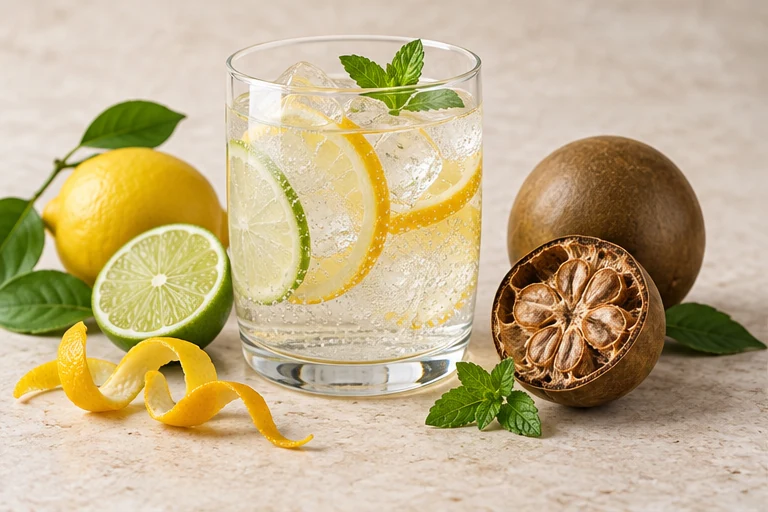
- Citrus sparkling drink · Pair a low-colour mogroside extract with citrus flavour, acidulant and, if useful, a second permitted sweetener
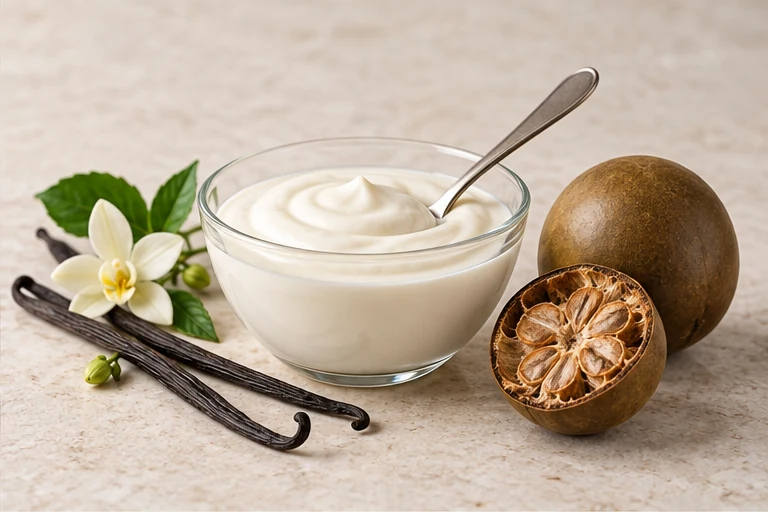
- Vanilla cultured dairy dessert · Combine a standardized monk fruit extract with a yogurt or cultured-dairy base, vanilla and a separately selected solids or texture system
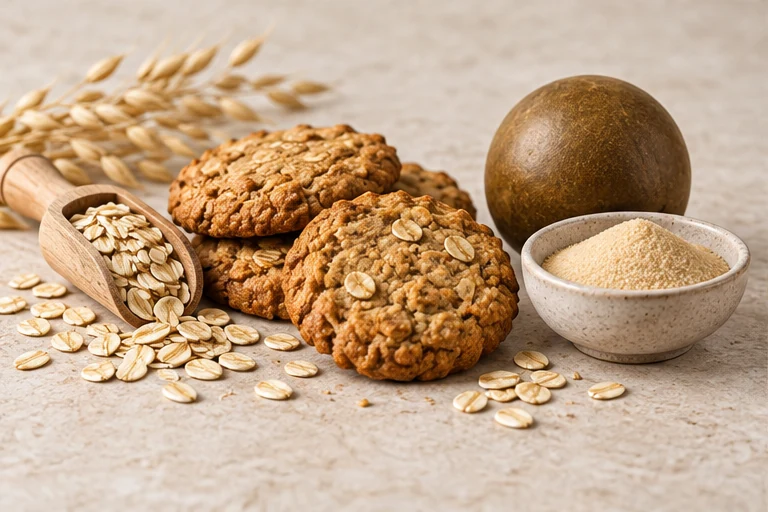
- Reduced-sugar oat cookie · Pair monk fruit extract with oats, flour, fat and a separately chosen bulking/humectant system
End-product selection
Reduced-sugar drinks, yoghurt, frozen desserts, bakery products and tabletop blends.
Sweetness-system development for drinks, fermented foods and reduced-sugar foods.
Three product development plans
These pilot concepts separate sweetness replacement from the bulk and texture functions of sugar. Compare each finished product with a sucrose control at the same serving temperature.
Citrus sparkling drink
Pair a low-colour mogroside extract with citrus flavour, acidulant and, if useful, a second permitted sweetener. The extract supplies sweetness; the partner sweetener can be screened for onset and lingering taste rather than assumed to act synergistically. The Tate & Lyle family below specifies one monk fruit/Reb A/Reb B combination, not every monk fruit–stevia blend.[14]
Prepare separate dilute sweetener stock solutions so small additions can be measured accurately. Blend into the water phase, add the acid and flavour system, then apply the selected beverage process. Carbonate after the appropriate cooling stage and evaluate the carbonated product, not only a still-water bench sample.
Measure sweetness onset, peak and aftertaste against sucrose, including acid bite and carbonic sharpness. Check haze, colour, mogroside recovery and flavour through the intended shelf life. EFSA records ingredient and model-system stability, but also the absence of a supplied food assay in the dossier; validate recovery in the actual drink.[20]
Vanilla cultured dairy dessert
Combine a standardized monk fruit extract with a yogurt or cultured-dairy base, vanilla and a separately selected solids or texture system. Monk fruit replaces sweetness; milk solids, protein and the chosen stabilizer provide structure. A higher V assay should not be assumed to improve taste at equal sweetness.
Develop and heat-treat the dairy base with its texture ingredients before fermentation. For a stirred product, evaluate a hygienically prepared sweetener/flavour premix added after fermentation alongside a pre-fermentation route. Keep acidification and culture performance under observation rather than assuming removing sucrose leaves fermentation unchanged.
Measure whey separation, viscosity, spoon texture, acidity and stored sweetness. Compare aftertaste at refrigerated serving temperature and check that vanilla does not conceal an unacceptable lingering note only in the fresh sample. The nutrition calculation must include lactose, any retained sugar and all bulking ingredients.
Reduced-sugar oat cookie
Pair monk fruit extract with oats, flour, fat and a separately chosen bulking/humectant system. Retain enough conventional sugar if the target texture needs it. High-intensity sweetness cannot reproduce all of sugar’s effects on dough spread, browning and water management; select the physical replacement before increasing extract to fix a weak cookie.
Make a uniform low-dose extract premix with part of the dry carrier or flour. Prepare the fat and bulk-sweetener phase, incorporate the remaining dry ingredients and then the extract premix with controlled mixing. Use the intended bake profile, cool fully and package only after assessing moisture equilibration.
Compare spread, thickness, breaking force, surface colour, water activity and stored crispness against the sugar control. Check sweetness at the baked stage, not in raw dough. Any polyol or fibre used for bulk needs its own gastrointestinal-tolerance, nutrition and market-use review; those properties do not belong to monk fruit itself.
Processing and equipment
A decoction retains a broader fruit-solids profile. Refined sweetener development adds selective adsorption and washing to separate sugars from mogrosides; concentration alone enriches both. Bakery and frozen products also need bulk and texture design.[5] [7]
For a fruit decoction, sorting, washing, controlled opening of the fruit, water contact and solid–liquid separation preserve a broad extract. An extraction tank controls time and temperature; a filter removes fruit tissue. Extra evaporation produces a concentrate, not selective mogroside enrichment. Record fresh or dried feed because yields on these bases are not comparable.[20][26]
For enriched extract, EFSA’s dossier describes water extraction, pectinase treatment, concentration and a resin column for the nominal 25% V grade. Higher grades undergo additional dissolution and resin adsorption/elution. The dossier’s proposed 25% grade specification allowed 3–6% saccharides; higher-grade specifications were below 1%. These are dossier-specific specifications, not universal properties of all 25% or 50% materials.[20]
Enzyme treatment should earn its place through lower viscosity, better filtration or improved target recovery. Set enzyme identity, activity units and inactivation conditions for the selected preparation. Before the resin, remove fine solids and colloidal burden; raising pump pressure does not correct an unsuitable feed. Follow mogroside V breakthrough in the outlet to decide when loading should stop.[20][13]
During washing and elution, collect fractions and measure mogrosides, residual sugars, colour and recovery. A narrow fraction may be purer but discard more target; prolonged washing also consumes water and can lose weakly retained compounds. Column equipment serves this selective separation. Drying follows solvent recovery and fraction selection, with the carrier declared in the final assay.[13][20]
Quality and safety
Specify plant identity, fresh/dried feed, native-extract and carrier content, V assay basis, broader mogroside profile and residual saccharides. Compare grades at equal perceived sweetness in the intended food; equal powder mass favours the more concentrated material without answering whether it tastes better or costs less per acceptable serving.
EFSA’s 2019 assessment recorded stability studies but found the toxicity database insufficient to conclude on the proposed food-additive safety. That conclusion belongs to that assessment and is not a current global authorization statement. Ingredient assay, sensory stability and legal use are three separate acceptance criteria.[20]
The FSA decision published on 26 June 2024 determined that non-selective aqueous decoctions of fresh or dried monk fruit were not novel, and explicitly applies to England and Wales. The defined material does not include every selectively enriched mogroside preparation. Match the manufacturing description and target market before transferring a regulatory status from one material to another.[26]
Buy this ingredient: specifications, COA, certification documents & pricing →
Practical questions
Does a decoction decision cover enriched mogrosides?
The FSA decision concerns non-selective aqueous decoctions and applies to England and Wales. Match the actual manufacturing route to that material definition.[26]
Research cases
Chiu and colleagues used Ganoderma lucidum mycelium to deglycosylate mogroside V toward mogroside III E, then purified the product using HP-20 macroporous resin. HPLC, mass spectrometry and NMR supported metabolite identification. The work changes molecular structure before separation; it is not simply purification of unchanged V.[21]
Reported III E purity rose from 11.71% to 54.19%, with 70–76% recovery. At the larger scale, the study’s purification table reports 17.38 ± 0.44 g of product containing 55.14 ± 2.44% III E, with 74.71 ± 1.41% recovery. The resin charge was 150 g. Further scale-up would need to control the culture medium, microbial quality and conversion by-products as well as adsorption and fraction collection.[21]
Relevant patents
WO2015168779A1
PCT application publication (A1). Original applicant/assignee: ZHANG, Yong Luke; LI, Cunbiao Kevin (WO cover (71)/(72); c/o GLG Life Tech Corporation). Priority / filing / publication: 2014-05-08 / 2015-05-08 / 2015-11-12.[13]
Published claim 1 passes a pre-prepared Siraitia extract through multiple serial columns packed with porous adsorbent resin and elutes V-containing fractions. Claim 5 specifies a primary-extract route including washed and mashed deseeded fruit, saccharification, extraction, filtration, concentration and centrifugation. Claim 6 adds optional colour, salt or impurity removal using membrane filtration, ion exchange or activated carbon. These dependent features should not be mistaken for mandatory elements of claim 1.[13]
The WO front page identifies Yong Luke Zhang and Cunbiao Kevin Li as applicants, with a c/o GLG Life Tech Corporation address; the address organization is not a separately named applicant. US20170150745A1 is a national member of this family, not an additional independent family. The engineering value is staged adsorption and fraction selection, not a guarantee of the advertised purity.[13]
BR112015002139B1
Brazilian patent grant (B1); Portuguese claims with English machine translation. Original applicant/assignee: Tate & Lyle Ingredients Americas Llc. Priority / filing / publication: 2012-08-01 / 2013-07-31 / 2020-03-10.[14]
Granted Brazilian claim 1 combines V-containing monk fruit extract, rebaudioside A and rebaudioside B. It specifies extract:(Reb A + Reb B) at 51:49–99:1, V:Reb A at 41:59–99:1 and Reb B at least 2 wt% of the defined sweetener components, including any additional steviol glycosides. Both extract-level and active-level ratios matter; substituting a new V grade changes the latter even if extract weight is unchanged.[14]
The record is a Brazilian grant, with original Portuguese claims and an English machine translation on Google Patents. Its relevance is sweetener composition and temporal taste design, distinct from the serial-column extraction family. It does not establish that all monk fruit–stevia combinations are covered or that this blend produces a clinical benefit.[14]
References
- WO2015168779A1 - Methods of extraction and purification of luo han guo mogroside v, natural sweetener compositions therewith and uses of said composition · 2026-09-11
- BR112015002139B1 - Sweetening composition comprising monk fruit extract comprising mogroside v, rebaudioside a and rebaudioside b, and food or drink composition · 2026-09-11
- EFSA monk fruit safety assessment full text · 2026-09-11
- Mogroside III E biotransformation primary full text · 2026-09-11
- Tey 2017 randomized crossover trial abstract · 2026-09-11
- FSA Article 4 decision: non-selective monk fruit decoctions · 2026-09-11
Material and processing background sources
- EFSA monk fruit additive assessment (2019) · 2026-09-09
- FDA GRN 301 record · 2026-09-09
- FSA non-selective monk fruit decoctions decision (2024) · 2026-09-09
- Biotransformation and MG III E resin purification (2020) · 2026-09-09
Related products and technical resources
Monk Fruit Extract
Specifications, samples and supply terms →
Application developmentFrom ingredient to end product
Formulation fit and testing priorities →
Related constituent family: definitions & assay boundaries →