Botanical refreshing beverage

A crisp botanical taste direction for a still or sparkling beverage. Refreshing describes sensory intent, not a stimulant effect or a guaranteed physiological benefit.

Where are you starting?

For brand founders, product managers and R&D / procurement teams with an existing formula. Define a reviewable scope first, then confirm executors and a quote.

I have an early idea

Share the audience, occasion, flavor preferences and market direction; budget, packaging and volume can be “to discuss”.

Shape my product idea

I have a formula to transfer

Share nonconfidential format, process stage, packaging and market; describe formula ownership and completed trials. Agree confidentiality and technical handover before sharing a formula, not through this form.

Review formula transfer needs

Proposed stage deliverables

These are discussion outputs, not an accepted R&D or manufacturing commitment; deliverables, executors and fees are agreed in writing per project.

  1. Brief review | direct coordination

    Proposed brief, target market and open-question list, with scope confirmed by the customer.

  2. Ingredient selection | direct coordination

    Proposed candidate-material table, specification/document requests and feasibility questions.

  3. R&D & packaging | executor to confirm

    Proposed prototype and stability protocol, packaging direction and acceptance criteria; qualified R&D, testing and design partners to be reviewed before execution.

  4. Transfer & production | written agreement

    Proposed transfer-gap review, pilot plan, responsibility matrix and delivery-document list; partner line, price, quantity and schedule require confirmation.

Illustrative concepts, not validated formulas, launched products or customer cases; no efficacy, dose or delivery promise. Market eligibility, labeling and safety require separate review.

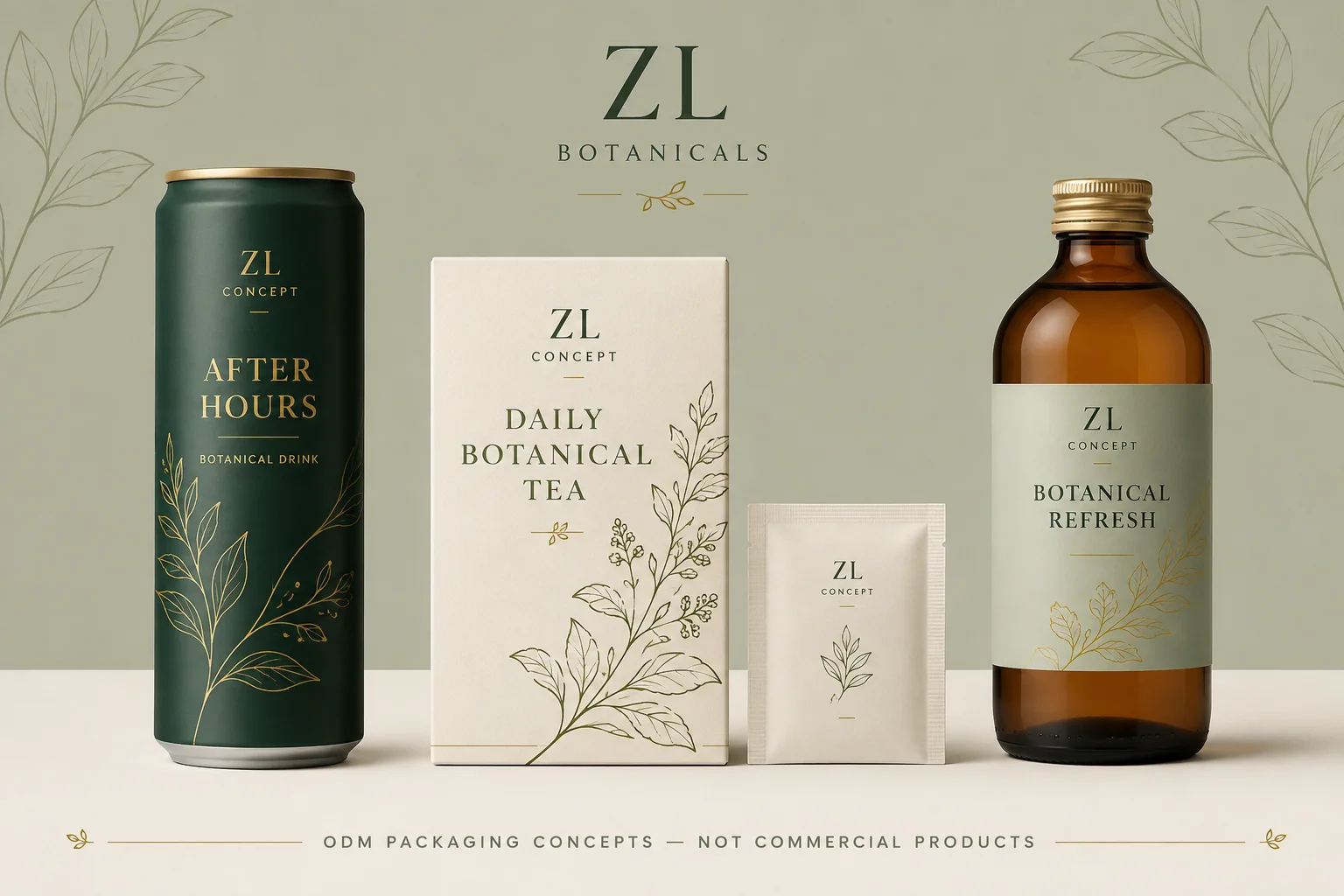
View packaging concept illustration (not actual goods)
Botanical packaging concepts: green can, ivory tea carton and amber bottle; not actual goods.
Packaging concept / visual direction, not a product photograph, launched range or packaging supply commitment. Wording is provisional design copy requiring trademark and label review.

Occasion & brief

Define a dry tea-forward or lightly sweetened taste, still versus sparkling format, acid profile and intended consumption occasion. Compare sweetened and unsweetened prototypes separately. Decide the target market before choosing any concentrated extract or sweetener grade.

Candidate ingredients & trade-offs

Green tea is a candidate for the botanical profile, with caffeine and catechin specifications reviewed independently. Monk-fruit or stevia grades are optional alternative sweetening routes, not a required blend. Check glycoside identity, production route, carrier composition and market permission for each candidate.

Proposed R&D validation plan

Compare sweetness onset, lingering notes, astringency, aroma and carbonation in the actual acid system. Plan clarity, foaming, dissolved-gas retention, color and microbial-control checks through the proposed filling cycle. Sensory prototypes are not evidence of shelf-life or health effects.

Packaging & visual direction

An amber bottle is a visual option to discuss alongside cans or other formats. Confirm pressure rating where carbonated, closure integrity, light transmission, process compatibility and transport tests. No bottle source, capacity, MOQ or filling slot is promised.

Connect the concept to ingredients & technical reading

Who does what: capability & responsibility boundaries

Direct coordination scope

Brief development, extract selection and procurement-document discussion, grounded in the extract business. Own production, partner supply or custom sourcing must be confirmed per SKU; a listing does not prove in-house manufacture.

Potential partner workstreams

Discuss potential R&D execution, testing, design, packaging-material and filling/manufacturing partners. Selection, qualifications, equipment and contracts require project review; no verified partner capacity is represented here.

Requires project confirmation

An owned R&D lab, filling line, certifications, clinical testing, shelf-life and delivery terms are not verified here. Agree outputs, release responsibility, formula/design ownership, failure costs and shipping terms in writing.

You do not need a finished formula to start

Bring the occasion, market, flavor preferences, exclusions and packaging idea. The next step is a feasibility discussion; do not send confidential formulas through the form.

Discuss this brief →

Literature · materials · boundaries

Research reading cards

Selected literature, not a live feed or systematic review. Editorial check: 2026-09-08; abstract-level reading, not medical or regulatory claim approval.

Shared reading limits: not finished-product efficacy evidence; no dose advice

Ingredient literature is not evidence of efficacy or safety for our extract or any finished product. No clinical validation, disease claim or market authorization is implied.

Review of heterogeneous studies: no single dose, population or duration is established by this card. Individual protocols and full text must be assessed before use. No serving dose is recommended.

Application filters describe reading relevance, not material suitability or local authorization.

3 reviewed entries on this page: Literature review • abstract-level editorial assessment (3)

Literature review • abstract-level editorial assessment · 2023

Tea-break with epigallocatechin gallate derivatives - Powerful polyphenols of great potential for medicine.

EGCG derivatives and stability, not a trial of a commercial green-tea beverage.

Study material, context & sources

Bakun P, Mlynarczyk DT, Koczorowski T, Cerbin-Koczorowska M, Piwowarczyk L, Kolasiński E, Stawny M, Kuźmińska J, Jelińska A, Goslinski T.

PMID: 37776575 · DOI: 10.1016/j.ejmech.2023.115820

Species & study material / specific limits
Camellia sinensis EGCG and chemically modified derivatives; not interchangeable with leaf extract.
Related ingredient science profile →

Literature review • abstract-level editorial assessment · 2024

Recent Advances in the Distribution, Chemical Composition, Health Benefits, and Application of the Fruit of Siraitia grosvenorii.

Fruit chemistry and applications; the review does not establish local food permission or finished-product benefits.

Study material, context & sources

Guo Q, Shi M, Sarengaowa, Xiao Z, Xiao Y, Feng K.

PMID: 39063362 · DOI: 10.3390/foods13142278

Species & study material / specific limits
Siraitia grosvenorii fruit constituents, with attention to mogrosides; grades are heterogeneous.
Related ingredient science profile →

Literature review • abstract-level editorial assessment · 2024

Properties, extraction and purification technologies of Stevia rebaudiana steviol glycosides: A review.

Extraction and purification technologies; operational choices require scale-specific validation.

Study material, context & sources

Huang C, Wang Y, Zhou C, Fan X, Sun Q, Han J, Hua C, Li Y, Niu Y, Emeka Okonkwo C, Yao D, Song L, Otu P.

PMID: 38761729 · DOI: 10.1016/j.foodchem.2024.139622

Species & study material / specific limits
Stevia rebaudiana steviol glycosides and separation processes, not a tested finished formulation.
Related ingredient science profile →
All research & editorial method →