Material identity
Resveratrol names a molecule, not one plant extract. Botanical knotweed roots/rhizomes, synthetic trans-resveratrol and microbial material require different source records; grape-seed extract is not synonymous.
Trans-resveratrol is 3,5,4′-trihydroxy-trans-stilbene, C14H12O3, molecular weight 228.25 Da and CAS 501-36-0 in EFSA’s material description.[3] A named molecule is not a specification for every commercial powder. The trans assay, cis/related compounds, source, moisture basis and carrier fraction must be identified separately.
Polydatin (piceid) is the glycoside precursor studied in knotweed hydrolysis, not free trans-resveratrol on an equal-mass basis.[5] A crude plant extract, a hydrolyzed purified ingredient and a carrier complex are different materials. Grape-seed extract is not a substitute name for this molecule; do not infer matching composition from a botanical marketing name.
Effects and human research
Turner et al. ran a randomized, placebo-controlled, double-blind, multicenter phase 2 trial in 119 people with mild-to-moderate Alzheimer disease over 52 weeks. Oral resveratrol started at 500 mg/day and increased by 500 mg every 13 weeks to 1,000 mg twice daily. The study used synthesized, encapsulated trans-resveratrol supplied under current Good Manufacturing Practices. The trial assessed safety and tolerability; its specified primary outcomes were biomarkers and MRI measures, with clinical scales as secondary outcomes.[6] These are supervised investigational doses in a disease population, not supplement instructions.
Resveratrol and metabolites were measured in plasma and CSF. The trial reported nausea, diarrhea and weight loss, altered Aβ40 trajectories and greater brain-volume loss with treatment; the interpretation of biomarker changes remained uncertain.[6] Detectable exposure or blood–brain-barrier penetration is not evidence of clinical benefit.
The trial was underpowered for clinical outcomes and found no significant effects on CDR-SOB, ADAS-cog, MMSE or NPI. ADCS-ADL decline was smaller in the treatment group (p=0.03), but this result lost significance in the post-hoc amyloid-defined subset (p=0.055).[6] This mixed finding does not establish treatment, prevention, longevity or cosmetic efficacy. The selected study is not a systematic review of every human indication.
Material forms and composition
Trans/cis identity, polydatin/piceid precursor, emodin and other source-specific impurities matter beyond main-peak purity.
Trans/cis identity, polydatin/piceid precursor, emodin and other source-specific impurities matter beyond main-peak purity.
Application selection
Purity and aqueous usability are independent. The 2015 study specifically examines how solubility/stability affect delivery research; apparent solubility changes must not be mistaken for stable target concentration.[4] Select the intended format—capsule/tablet, suspension/emulsion, clear drink or topical preparation—before buying crystals, micronized powder or a carrier grade.
| Task | Physical question | Useful comparison | Insufficient evidence |
|---|---|---|---|
| Capsule/tablet | Mixing, flow, dose, dissolution and storage | Matched loading/excipients, uniformity and chromatographic dissolution | Raw-material main-peak purity alone |
| Clear aqueous product | Equilibrium solubility, cooling and light | Supernatant, turbidity, precipitate and degradants | Clear hot preparation immediately after mixing |
| Emulsion/dispersion | Particle growth, settling, loading and phase distribution | Carrier blank, unformulated control, total/dissolved fractions | Small particle size as proof of human bioavailability |
| Topical product | Compatibility, crystallization, packaging and local suitability | Final-formula storage, microscopy and claim studies | Oral or isolated-cell findings as skincare efficacy |
These are proposed development tests. Loading, encapsulation efficiency, trans mass per serving and free fraction need separate definitions. A “10%” label can describe different quantities. Supplier methods and composition should precede brand claims. Auxiliary antioxidants or light-protective packaging do not eliminate the need for chemical stability measurement.[4]
A proposed matrix uses the same ingredient lot, a carrier candidate and carrier blank under final pH/packaging, with dark/light and routine/accelerated conditions. Follow total material, trans-specific assay, degradants and physical state. Falling supernatant with unchanged total suggests precipitation/adsorption; falling total trans prompts degradation/isomerization investigation. The corrective actions differ.
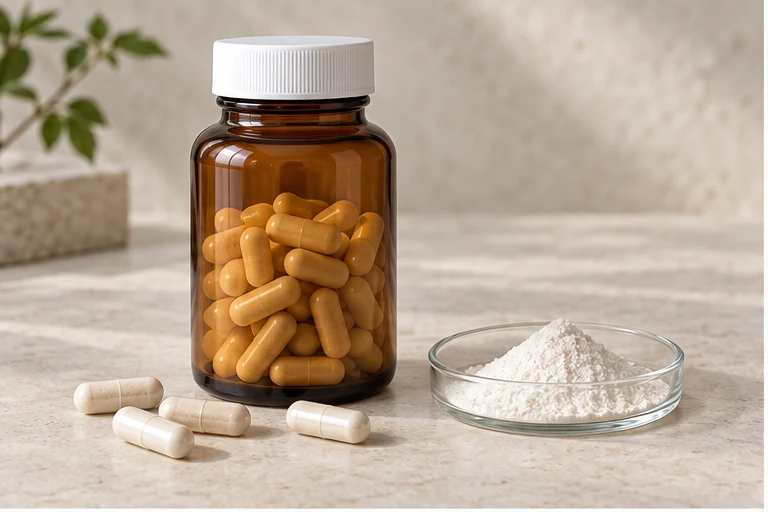
- Dry capsule: assay-led blending · Trans-resveratrol is the assayed ingredient; microcrystalline cellulose is a candidate diluent; colloidal silica supports flow; a capsule shell contains the blend
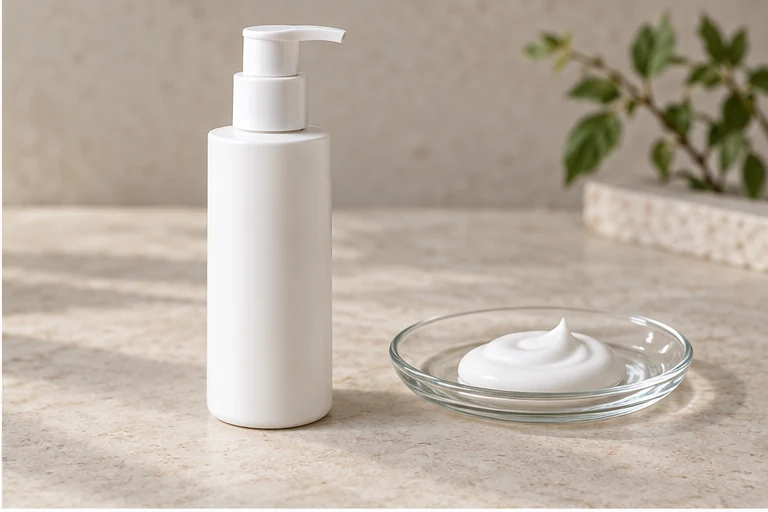
- Topical emulsion: solvent and emulsifier pairing · Resveratrol is the target ingredient; dimethyl isosorbide is the candidate solvent; an emollient oil provides the oil phase; glyceryl stearate/PEG-100 stearate is a candidate emulsifier pair; water is the continuous phase
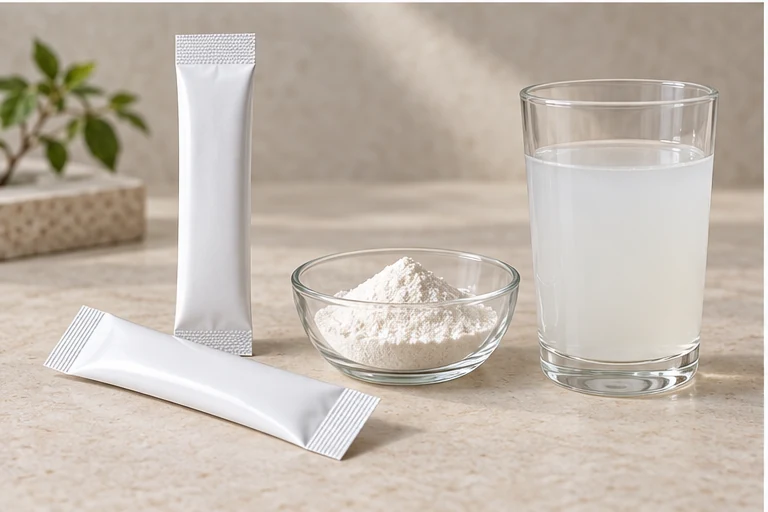
- Reconstitution powder: cyclodextrin carrier · Resveratrol is the assayed guest; a jurisdiction-permitted cyclodextrin is the candidate host; a permitted bulking agent supports sachet filling; flavor is optional
End-product selection
Capsules/tablets and separately tested dispersion or topical concepts; a clear drink is not assured.
Oral solids, suspensions/emulsions and topical development, with route-specific evidence.
Three product development plans
These are proposed bench studies. Before testing, set the target loading, sampling times and written acceptance limits for assay, individual-unit content, uniformity, dissolution or redispersion, and storage stability. Establish microbial safety for aqueous products and skin tolerability for the topical formula separately.
Dry capsule: assay-led blending
Trans-resveratrol is the assayed ingredient; microcrystalline cellulose is a candidate diluent; colloidal silica supports flow; a capsule shell contains the blend.
Confirm assay and moisture basis → sieve components separately → geometrically dilute resveratrol into cellulose → blend → add silica late and briefly → sample blend → fill capsules → pack in a light-protective container. Set serving mass only after regulatory review.
Compare segregation at different particle sizes, blend uniformity, fill mass and dissolution using a trans-specific method. Check moisture transfer from shell and excipient compatibility under storage. Reject an assay-only release rule; the solid supplement format is within the material-specific EFSA dossier, not proof that this proposed formula is authorized.[3][4]
Topical emulsion: solvent and emulsifier pairing
Resveratrol is the target ingredient; dimethyl isosorbide is the candidate solvent; an emollient oil provides the oil phase; glyceryl stearate/PEG-100 stearate is a candidate emulsifier pair; water is the continuous phase. A preservation system requires separate selection. Solvent and emulsifier examples have patent precedent, not guaranteed skin benefit.[7]
Screen solubility in the candidate solvent first → prepare oil/emulsifier and water phases separately → emulsify under controlled mixing → introduce the resveratrol premix at a validated temperature compatible with the system → cool, deaerate and fill. This sequence is a proposed screen, not a transcription of a patented example.
Check crystal formation after dilution/cooling, microscopy, droplet growth, phase separation, preservative efficacy and final-formula skin tolerability. Use carrier blanks and unformulated material as analytical and physical controls; do not assume these controls are suitable for application to human skin. Screen packaging and trans retention. Do not assume extra solvent or emulsifier improves tolerability. Review relevant claims before commercialization.[4][7]
Reconstitution powder: cyclodextrin carrier
Resveratrol is the assayed guest; a jurisdiction-permitted cyclodextrin is the candidate host; a permitted bulking agent supports sachet filling; flavor is optional. Carrier eligibility must be checked for intended oral use: patent lists are not food-permission lists.[8]
For a supplied dry complex, verify loading before blending. For an in-house process, complete legally reviewed complexation, isolation, drying and assay first. Blend the qualified dry complex with bulking/flavor ingredients, fill moisture/light-protective sachets, and test reconstitution at intended dilution. The cited patent describes heating, solvent addition, slow cooling and crystal isolation; dry blending alone does not prove inclusion complex formation.[8]
Test free/total trans, loading basis, residual solvent, water content and redispersion; measure supernatant after cooling and standing. Screen acid/flavor competition and carrier ratio rather than assume compatibility. Release on retained trans plus physical stability, not initial clarity. No human absorption or benefit advantage is established for this proposed product.[4][8] If claiming an inclusion complex, establish a method that distinguishes inclusion from a physical mixture.
Processing and equipment
Botanical recovery must distinguish free compound extraction from precursor hydrolysis and remove source-specific coextractives. Purified crystals for capsules and carrier preparations for dispersions need different downstream work; higher purity does not establish aqueous solubility.[20] [30] [41]
Resveratrol is not synonymous with grape-seed extract. Botanical preparations may contain resveratrol, its glycoside precursor and other constituents; purified trans-resveratrol is a molecularly defined material; synthetic sources create different process and regulatory identities. The knotweed study follows resveratrol, polydatin/piceid and emodin, whereas EFSA’s synthetic-material assessment identifies related synthetic compounds and residual diisopropylamine.[5][3]
| Source/product | Transformation | Priority controls | Identity error |
|---|---|---|---|
| Knotweed extract | Multiple plant compounds enter solvent | Polydatin, emodin, other anthraquinones/unknowns | Extract ratio as trans assay |
| Hydrolyzed/purified knotweed | Precursor loses sugar and generates resveratrol | Remaining precursor, by-products, anthraquinones, solvents | Conversion yield confused with free-resveratrol recovery |
| Synthetic trans compound | Skeleton formation, deprotection and crystallization | Related compounds and reagents | Same main peak assumed to mean same impurity profile |
| Carrier preparation | Dispersion/loading in a formulated matrix | Carrier, free fraction, particles and degradants | Dispersibility equated with solubility or clinical absorption |
A public plant-process example—100 g dried knotweed root, not an industrial SOP. Wang, Liu and Chen used approximately 40-mesh root powder, soaked 100 g with 95% ethanol at 1:6 g/mL for about 12 hours, then refluxed at about 80°C three times for one hour each. Combined extract was rotary-evaporated under vacuum at 65°C.[5] Dry-extract yield was 13.3% of starting powder, while resveratrol was 3.3% of that extract. These different denominators must remain explicit.[5]
The dried extract was milled, mixed with water at 1:30 g/mL, treated in an ultrasonic bath at 50°C for 20 minutes and filtered. The aqueous phase was adjusted with hydrochloric acid to pH 1 and reflux-hydrolyzed at 75°C for 8 hours.[5] Polydatin conversion contributed newly formed free resveratrol. The approximately fourfold increase reported by the authors is not 400% recovery of the initial free compound.[5] Follow precursor disappearance, product formation and unknown/degradation peaks together.
The study used repeated equal-volume liquid–liquid extraction and washed the organic phase with alkaline aqueous solution at pH 8–9, exemplified by 5% sodium bicarbonate, approximately twice at equal phase volumes.[5] The final product contained over 73.8% resveratrol—not a commercial high-purity trans grade. Subsequent preparative-HPLC isolation for MS/NMR identity confirmation does not establish that purity for the entire final batch.[5]
The authors compared direct aqueous dilution of concentrated ethanol extract with drying and redispersion. The former removed some low-polarity compounds less effectively; they proposed that the latter promoted aggregation that could be filtered, while noting incomplete supporting figures.[5] Filtration therefore depends on upstream solvent/particle history as well as pore size. An energy-saving alternative that omits drying must demonstrate impurity removal and recovery equivalence.
For comparison, EFSA’s assessed synthetic product used a Wittig reaction, a trimethoxy intermediate and demethylation involving aluminium chloride and diisopropylamine, followed by isopropanol/water crystallization and ethanol/water recrystallization.[3] This creates a different impurity brief from knotweed. Public descriptions do not provide a complete batch-scale synthesis recipe.[3]
| Unit | Required evidence | Failure investigation |
|---|---|---|
| Reflux extraction/recovery | Target and anthraquinone recovery by cycle, solvent balance | Longer extraction increasing impurities rather than selectivity |
| Acid hydrolysis reactor | Time profiles of precursor, trans and degradation/isomer peaks | Acid type, residence and contact materials changing side reactions |
| Liquid–liquid contacting/separation | Target mass in both phases, emulsion losses and settling | Higher shear causing persistent emulsions |
| Washing/crystallization | Crystal/mother-liquor assays, entrainment and particle properties | High purity with poor recovery or impurity carryover |
| Light-controlled formulation/packaging | Trans retention and stability-indicating profile | UV absorbance hiding loss of trans compound |
| Particle/carrier processing | Total/dissolved fractions, particle size and storage | Attractive initial dispersion hiding cold precipitation |
These are engineering recommendations. The original work used flasks, an ultrasonic bath, a rotary evaporator and separating funnels, not validated continuous production equipment.[5] Scale-up requires heat-transfer, corrosion, contacting, settling and solvent-safety assessment, not multiplication of laboratory minutes by batch mass.
Documented failure 1—acid identity matters. The knotweed authors initially used sulfuric acid at pH 1 and reported susceptibility of resveratrol and polydatin to oxidation under those conditions, then selected hydrochloric-acid reflux hydrolysis at the same pH.[5] This does not establish universal sulfuric-acid failure, but it invalidates an assumption that acids are interchangeable at equal pH. Investigate acid identity, contaminants, oxygen, metal contact and residence.
Documented failure 2—analytical signal can conceal degradation. Zupančič et al. found relative stability in acidic conditions and increasing degradation above pH 6.8 in their experiments. UV/VIS gave falsely high trans-resveratrol concentrations under unstable alkaline, light and elevated-temperature conditions; HPLC and UPLC specificity was confirmed.[4] Only the abstract was retrieved, without complete batch volume/concentration/time details, so pH 6.8 is a study observation, not a universal formulation prohibition. Long dissolution and cell assays need actual trans exposure measurements.
Quality and safety
A concrete QA lesson appears in EFSA Table 2: three mercury results were reported as ≤1.0 mg/kg against a ≤0.1 mg/kg specification, and the opinion noted noncompliance with that specification.[3] Do not reinterpret this as measured mercury of exactly 1 mg/kg in each batch. The reporting threshold cannot demonstrate compliance with the lower limit; a sufficiently sensitive retest is needed. Supplier analytical/reporting limits must support the acceptance decision.
Use chromatography capable of resolving isomers and relevant impurities, rather than nonspecific UV absorbance under unstable conditions.[4] For knotweed, track polydatin, emodin, other anthraquinones and unknowns through clearance; the original study used C18 chromatography, external standard quantitation and MS/NMR identity confirmation.[5] Synthetic routes need a process-specific related-compound/reagent list; EFSA’s diisopropylamine and related-substance controls are specific to its evaluated process, not universal to all sources.[3]
Certificates should specify dry/as-is basis, moisture, ash, solvents, carrier and active mass. A hypothetical 1 g formulated material containing 10% trans on the entire as-is preparation basis corresponds to 100 mg nominal input; that calculation fails if 10% means dry basis or encapsulation efficiency. This is a metrology example, not an intake recommendation. Molecular identity does not erase botanical part, extraction solvent, precursor hydrolysis or source impurities.
Buy this ingredient: specifications, COA, certification documents & pricing →
Practical questions
Does 99% mean water-soluble? No. Assay, dissolved concentration and dispersion are different measurements. Use the final temperature, pH, carrier and package in stability tests; the stability paper’s pH 6.8 observation is not a universal cutoff.[4]
Does higher absorption mean better health outcomes? No. Pharmacokinetic exposure and patient benefit are separate endpoints; the Alzheimer trial’s biomarker findings do not establish broad cognitive benefit.[6]
Is 150 mg/day a universal safe dose? No. EFSA’s 2016 opinion considered a specified ≥99% synthetic trans material for adult capsule/tablet supplements under proposed conditions, concluded that intended 150 mg/day did not raise safety concerns, and warned about possible CYP2C9 medicine interactions.[3] It is not an efficacy opinion or a current worldwide authorization. Do not extrapolate to children, pregnancy, all sources or arbitrary doses; check local rules and obtain clinical advice when medicines are used.
Can precursor hydrolysis be called 400% recovery? No. The plant paper’s roughly fourfold output increase includes conversion of polydatin into resveratrol; final product assay exceeded 73.8%, not 99%.[5] Track precursor and free molecule separately.
Research cases
The knotweed paper connects solubility, acidity and hydrolysis to measurable fractionation, while its approximately 73.8%-grade endpoint exposes the remaining gap to highly purified material.[5] The stability study reveals why analytical methods can misstate exposure in prolonged cell/dissolution experiments.[4] EFSA evaluates source, impurities, intake and toxicology as one defined material rather than inferring high-intake safety from natural occurrence.[3]
| Role | Handover | Error avoided |
|---|---|---|
| R&D | Isomer/precursor profile, dissolved fraction and carrier controls | Precipitation/degradation misread as biology |
| Engineering | Root/extract/target balances, acid/residence and phase losses | Fourfold conversion increase called 400% recovery |
| Procurement | Source, assay basis, carrier and impurity profile | Comparing unlike products by the same main peak |
| QA | Stability method and specification/reporting-limit match | “≤1.0” accepted against “≤0.1” |
| Brand | Evidence matching source, format and final product | Natural occurrence or particle size turned into clinical benefit |
Relevant patents
WO2009129627A1
PCT application publication A1. Applicants for designated states except the US: Pharmascience Inc.; US-only inventor/applicants Pascale Clément and Mikaela Teris. Priority / filing / publication: 2008-04-25 / 2009-04-24 / 2009-10-29.[7]
Claim 1 requires topical solubilized resveratrol in a stable emulsion, a solvent system comprising dimethyl isosorbide, and non-irritation. It is not a monopoly on all resveratrol or all solvents.[7]
Directly relevant to solvent/emulsifier pairing and precipitation control in the proposed topical product.[7]
WO2009012551A1
PCT application publication A1. Applicants for designated states except the US: União Brasileira de Educacao e Assistencia-Mantenedora da PUCRS; Eurofarma Laboratórios Ltda.; US-only inventor/applicant André Arigony Souto. Priority / filing / publication: 2007-07-23 / 2008-07-23 / 2009-01-29.[8]
Claim 1 is a process: cyclodextrin at saturation in water at 50–80°C, water-miscible physiologically acceptable organic solvent at organic-solvent:water 1:1–1:5, addition of a resveratrol solution and heating at 50–80°C, slow cooling to precipitate complex crystals, and separation. It does not merely claim mixing any powder with cyclodextrin.[8]
Directly relevant to carrier preparation before a reconstitution product. EP2178525A1, published 2010-04-28, is a family member, not a third distinct invention.[8]
References
- https://patents.google.com/patent/WO2009129627A1/en · 2026-09-11
- https://patents.google.com/patent/EP2178525A1/en · 2026-09-11
- EFSA: safety of specified synthetic trans-resveratrol (2016) · 2026-09-11
- Resveratrol solubility and stability study (2015; abstract) · 2026-09-11
- Resveratrol recovery and polydatin conversion from knotweed (2018) · 2026-09-11
- Turner et al.: randomized resveratrol trial in Alzheimer disease (2015) · 2026-09-11
- https://patentimages.storage.googleapis.com/bd/08/cb/b0053cccc82778/WO2009129627A1.pdf · 2026-09-11
- https://patentimages.storage.googleapis.com/83/a2/11/343f9ebf0e6f19/WO2009012551A1.pdf · 2026-09-11
Material and processing background sources
- Implementing regulation - 2022/672 - EN - EUR-Lex · 2026-09-09
- COMMISSION IMPLEMENTING DECISION (EU) 2016/ 1190 - of 19 July 2016 - authorising the placing on the market of trans-resveratrol as a novel food ingredient under Regulation (EC) No 258 / 97 of the European Parliament and of the Council - (notified under document C(2016) 4567) - (Only the English text is authentic) · 2026-09-09
- EFSA opinion on the safety of synthetic resveratrol vom 15.12.2015 · 2026-09-09
- Stability and solubility of trans-resveratrol are strongly influenced by pH and temperature · 2026-09-09
- PMC5760951 full-text XML, Europe PMC · 2026-09-09