Licorice and liquorice extracts: names and material types
Glycyrrhiza roots and stolons; identify the species rather than relying on the common name. Glabridin-oriented material specifically requires authenticated G. glabra.
Licorice and liquorice are American and British spellings of the same common name. Licorice root extracts nevertheless differ by Glycyrrhiza species, extraction process and composition. Conventional extracts retain a mixed profile; deglycyrrhizinated licorice (DGL) has much of its glycyrrhizin removed; glabridin-rich materials represent a different formulation choice. The shared name does not make these materials interchangeable at the same addition rate.[1][4][8]
Effects and human research
Licorice is used for flavor and studied for digestive, oral and skin applications. These uses do not describe a single interchangeable ingredient: glycyrrhizin-rich extract, deglycyrrhizinated licorice (DGL) and glabridin-rich material have different compositions and research records.[1][8]
A small randomized, double-blind, placebo-controlled trial assigned 50 patients with functional dyspepsia to a specified G. glabra extract (GutGard) or placebo. The extract was given at 75 mg twice daily for 30 days; symptom scores and the Nepean dyspepsia index improved relative to placebo. Its specifications included glabridin ≥3.5%, total flavonoids ≥10% and glycyrrhizin ≤0.5% by weight. This supports a short-term signal for that extract, not an efficacy claim for every DGL chewable or licorice tea.[4]
NCCIH concludes that high-quality evidence is insufficient to clearly support licorice for any health condition and that digestive effects of licorice alone remain unclear. It describes preliminary signals for mouth rinses in recurrent canker sores, perioperative gargles or lozenges for post-intubation sore throat, and topical gels for eczema or burns. These studies concern specific preparations and settings, not routine self-treatment of those conditions.[8]
Glabridin has laboratory evidence for tyrosinase-related pigmentation effects and antioxidant and anti-inflammatory activity; much of the literature is preclinical. A 2025 cell study showed that solvent dilution can precipitate glabridin crystals and distort both cytotoxicity and apparent pigmentation effects. A dissolved concentration and a nominal dose are not necessarily the same exposure.[1][3]
Glycyrrhizin, DGL and glabridin: how specifications differ
Glycyrrhizin/glycyrrhizic acid, deglycyrrhizinated licorice (DGL), total flavonoids and glabridin are different identities.
Glycyrrhizin, also called glycyrrhizic acid in the cited health sources, is a sweet triterpenoid saponin associated with licorice’s mineralocorticoid-like adverse effects. Glycyrrhetinic acid is its aglycone, not glabridin. Commercial salts require a stated assay basis; free acid, ammonium salt and extract mass should not be compared as if they were the same quantity.[1][6][8]
DGL is a mixture produced by removing much of the glycyrrhizin. The name does not specify which flavonoids remain or establish zero residue. Glabridin is a distinct isoflavan associated with G. glabra; total flavonoids are not a glabridin assay. G. uralensis, G. inflata and G. glabra should not be substituted without botanical and chemical equivalence data for the intended specification.[1][4][7]
Choose cut root or conventional extract for a licorice flavor brief; choose a defined low-glycyrrhizin mixture for an oral DGL project; choose an assayed glabridin-rich fraction or formulated dispersion for topical development. A 10:1 extraction ratio alone answers none of the composition questions. These are development selection rules, not product approvals. Licorice-like candy may instead use anise flavor and cannot be assumed to contain licorice.[8]
Application selection
Licorice root preparations have flavoring and supplement use histories; glabridin literature separately examines topical delivery.[6][1] A DGL formula dossier should combine residual glycyrrhizic acid, retained-marker fingerprint, actual daily ingredient mass and other licorice sources. Flavor screening should also record color, bitterness, licorice-like aftertaste and dissolution rather than compare price per kilogram alone.
For topical glabridin, the proposed test chain is raw material → premix → emulsion phase → finished product → use dilution. At each stage, compare total assay, filtered-supernatant assay and microscopy. An unchanged total assay can conceal precipitation. Cyclodextrin complexes, nanoemulsions and porous carriers are different formulated materials; carrier percentage and loading determine glabridin per gram of the supplied powder.[1][3]
Compare unformulated powder, a premix and candidate carriers at matched glabridin dose, including carrier blanks. Test final packaging under dark, light and thermal conditions. Physical stability and chemical retention should precede skin suitability and finished-product claim studies. Cell and animal findings on different materials do not establish a brand’s clinical or cosmetic performance.[3][1]
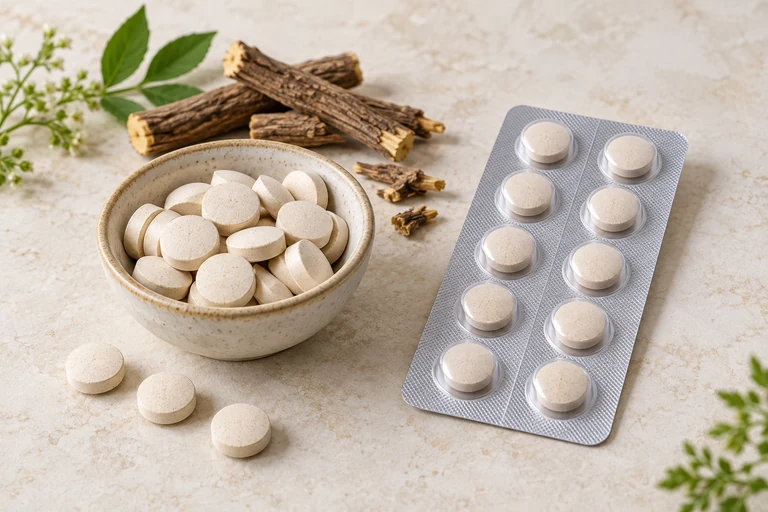
- DGL chewable with a mannitol–cellulose tablet base · Defined DGL supplies the licorice mixture; require residual glycyrrhizin and retained-flavonoid assays
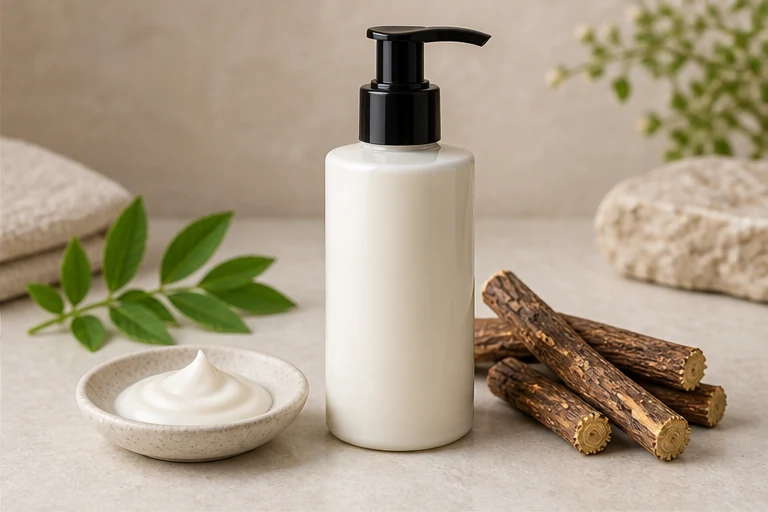
- Glabridin + glycerin + emollient oil-in-water lotion · Assayed glabridin-rich material is the researched botanical component; glycerin is proposed as a humectant and the emollient phase provides slip
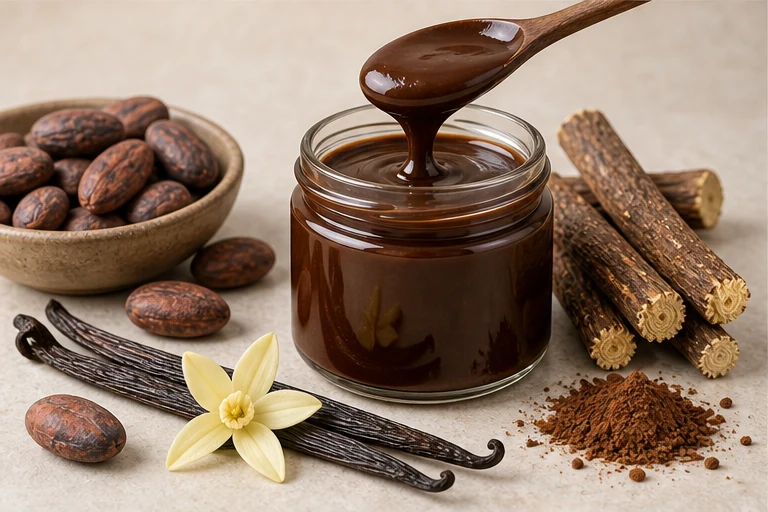
- Licorice + cocoa + vanilla flavor concentrate · Conventional licorice extract supplies the intended licorice note; cocoa provides the main chocolate profile and vanilla rounds the aroma
End-product selection
Flavour concentrates, DGL capsule/tablet concepts and glabridin cream or emulsion concepts.
Flavour formulation, oral-solid development and separately assessed topical glabridin systems.
Three product development plans
These are bench-development plans. Set ratios, pH, processing conditions and shelf life through testing of the specified ingredient and finished product.
DGL chewable with a mannitol–cellulose tablet base
Defined DGL supplies the licorice mixture; require residual glycyrrhizin and retained-flavonoid assays. The clinical reference is a different specified extract, not this finished tablet.[4]
Mannitol is proposed for bulk and mouthfeel; microcrystalline cellulose for tablet structure; a disintegrant for breakup and a low-level lubricant for ejection. A compatible flavor masks the botanical aftertaste.
Sieve and assay the DGL; geometrically premix it with part of the filler before adding the remaining filler and disintegrant.
Add lubricant last with a controlled short blend; compress over a trial pressure range, then pack in a moisture-protective format. Set serving size only after composition and exposure review.
Measure blend and unit uniformity, hardness, friability, disintegration, moisture and taste at release and on stability. Investigate segregation if tablet mass passes but marker content varies.
Calculate residual glycyrrhizin per maximum daily serving, including other licorice ingredients. Do not substitute a low assay on diluted powder for selective removal.
Glabridin + glycerin + emollient oil-in-water lotion
Assayed glabridin-rich material is the researched botanical component; glycerin is proposed as a humectant and the emollient phase provides slip. An emulsifier stabilizes droplets and a compatible preservation system protects the water-containing product.
Select a cosmetically acceptable solvent or an already characterized carrier for glabridin. A clear stock solution does not prove the final lotion remains free of crystals.[3]
Screen glabridin solubility in the proposed carrier, including after dilution. Prepare the aqueous humectant phase and oil/emulsifier phase separately under supplier-compatible conditions.
Emulsify with controlled shear, cool, and add the glabridin concentrate at the stage supported by stability tests; adjust pH, add the validated preservation system and deaerate before filling.
Track total and supernatant glabridin, microscopy, droplet size, viscosity, pH and color through temperature cycling and light exposure. A successful total assay can hide precipitated active.[3]
Run preservative challenge, packaging compatibility and finished-product skin tolerance tests. Do not infer sunscreen protection or proven wrinkle reduction from enzyme studies in an application publication.[10]
Licorice + cocoa + vanilla flavor concentrate
Conventional licorice extract supplies the intended licorice note; cocoa provides the main chocolate profile and vanilla rounds the aroma. Sugar or another permitted bulk sweetener sets sweetness and solids independently of licorice dose.
A stabilizer is proposed to suspend cocoa, not to remove glycyrrhizin. The historical patent combines cocoa and vanilla with essentially glycyrrhizin-free fractions that lack licorice’s characteristic flavor. Those fractions are distinct from the conventional extract used here for a licorice note.[9]
Dissolve the measured licorice extract separately, disperse cocoa with part of the sweetener, and hydrate the stabilizer by its validated procedure. Combine while recording solids and pH.
Screen bench blends across licorice intensity, then validate an appropriate heat treatment and filling process for the selected food format. Add aroma at a compatible stage and verify flavor after the full heat history.
Check sediment, viscosity, sweetness timing, bitter or lingering notes, microbial stability and serving dilution. Label the concentrate dilution clearly; evaluate glycyrrhizin in the consumed serving, not just per gram of concentrate.[8]
If a DGL flavor fraction is substituted, rework the sensory target rather than increasing dose to recover missing sweetness. Verify the destination-market permission for the actual extract and food category before commercialization.
Processing and equipment
Conventional extract retains a mixed profile; DGL separates glycyrrhizic acid from desired constituents and needs a numerical residual assay. Glabridin enrichment is another fractionation target, followed by dispersion testing for topical use.[4] [28] [44] [48]
Licorice is not adequately defined by an extract ratio. Glycyrrhizin/glycyrrhizic acid, a deglycyrrhizinated mixed extract (DGL), and glabridin are different material targets. Glabridin is a species-associated isoflavan marker of Glycyrrhiza glabra; total flavonoids, DGL and glabridin cannot be used as interchangeable specifications.[7][6][1]
| Product target | Material to retain | Separation task | Identity trap |
|---|---|---|---|
| Conventional extract or glycyrrhizic-acid-rich fraction | Mixed extractives or the specified glycyrrhizic acid component | Extraction/concentration versus selective enrichment | Extract ratio mistaken for assay; acid/salt reporting mismatch |
| DGL | Defined non-glycyrrhizic constituents | Separate glycyrrhizic acid from desired flavonoids | “Removed” interpreted as absolute zero; total flavonoids called glabridin |
| Glabridin-rich extract or isolated compound | Glabridin from authenticated G. glabra | Fractionation, enrichment and compound-level purification | A mixed DGL extract presented as purified glabridin |
Fu et al. compared XDA-1, LSA-10, D101 and LSA-20 resins. Their accessible abstract reports higher adsorption capacity of XDA-1 for both constituent classes and greater affinity for licorice flavonoids. One column separation produced a flavonoid-rich fraction of approximately 21.9% purity and a glycyrrhizic-acid-rich fraction of 66% purity.[7] These are study results, not universal DGL specifications. The abstract says “free of GA”; its corresponding quantitation limit was not available in the retrieved excerpt, so a commercial specification needs a validated numerical residual limit.[7]
The proposed DGL development sequence is clarification, dual-marker feed assay, pH-dependent dynamic loading studies, fraction collection, mass balance, concentration and drying, followed by repeat residual and fingerprint testing. The accessible abstract says adsorption capacity depends strongly on feed pH; it does not provide a complete operating window. Higher capacity alone does not establish better separation.[7] Record target mass in feed, breakthrough, washes, eluates and regeneration streams. No universal pH, bed-volume rate or ethanol gradient is supplied because the complete column method was not retrieved.
The glabridin route starts with a different botanical and chemical target. Simmler et al. report literature concentrations of 0.08–0.35% of root dry weight, together with tissue localization and geographical/environmental variation; these are observations, not incoming-lot guarantees.[1] Extraction, liquid–liquid partition, adsorption, preparative chromatography and/or crystallization are candidate operations. Historical isolation methods often needed three or four chromatographic/partition stages and sometimes used benzene or chloroform; these solvents are not recommended here for commercial food or cosmetic production.[1] Replacement solvent systems require demonstrated selectivity and impurity control, not merely an acceptable solvent name.
The review reports approximately 150-fold enrichment and 80% glabridin recovery with HPD100, while molecularly imprinted polymer methods recovered only 42–56%, with glabridin also appearing in wash fractions.[1] These secondary-reported laboratory results illustrate why enrichment factor and total recovery must be evaluated together. They are not independently verified production-scale capacities.
| Unit | Required performance evidence | Failure to investigate |
|---|---|---|
| Extraction and clarification | Particle size, extraction curve, filtrate turbidity and pressure drop | Excess fines overloading clarification |
| DGL adsorption column | Dual-component breakthrough, fraction cuts and regeneration repeatability | High capacity but overlapping elution bands |
| Glabridin enrichment/preparative separation | Marker and neighboring peaks, recovery and retained mass | Irreversible adsorption or oxidation reducing yield |
| Vacuum concentration/recovery | Product temperature, residence, condensation and residual solvent | Concentration mistaken for selective glycyrrhizic-acid removal |
| Formulation/mixing/encapsulation | Dissolved assay after dilution, morphology, loading and stability | Visual uniformity mistaken for molecular dissolution |
These are engineering recommendations grounded in the adsorption, isolation and formulation literature.[7][1][3] Ethanol recovery, ventilation, explosion protection, cleaning and waste handling belong in the equipment scope. Bed geometry should follow dynamic capacity, flow demand, pressure drop and regeneration—not a generic “DGL machine” label.
A documented 2025 failure case is particularly useful: glabridin dissolved in DMSO became turbid and formed needle-like crystals when diluted into PBS; crystals increased and sedimented over time.[3] The laboratory method diluted a 20 mg/mL stock to 100 μg/mL and followed room-temperature samples for up to 120 minutes with filtered-supernatant HPLC. Total preparation batch volume was not given in the passage examined.[3] The authors associated precipitation with reduced dissolved exposure and possible physical cellular injury. This justifies microscopy and soluble-fraction measurement during validation, not copying an encapsulation recipe. Apparent ratio/vacuum-unit problems elsewhere in that paper were not reproduced as manufacturing instructions.
Engineering proposal: use an agitated extraction vessel with controlled particle feed, a pressure-monitored filter and a sampled adsorption skid rather than specifying equipment by extract ratio. Match vacuum evaporation to solvent recovery; evaluate spray drying for a standardized bulk powder and vacuum drying for heat-sensitive fractions. Qualify outlet/product temperature, residence time, moisture, marker retention, powder yield and wall deposits in pilot runs. Closed solvent handling and suitable ventilation and explosion protection are required where flammable solvents are used; membrane clarification is not assumed to remove glycyrrhizin selectively.
Quality and safety
A DGL certificate should answer both “how much glycyrrhizic acid remains?” and “what was retained?” The proposed method package aligns dry/as-is basis, acid/salt conversion, reference-standard correction and excipient status, and establishes specificity, recovery and quantitation limit. Glabridin assay should be accompanied by botanical identity and fingerprint information; purified research compounds may require orthogonal MS/NMR confirmation. The review highlights incomplete purity reporting and overreliance on HPLC-UV in earlier studies.[1]
Solvent history determines residual-solvent tests; origin and intended use inform pesticide, elemental and microbiological controls. Resin extractables, regeneration-agent carryover and shared-line cleaning are risk-based QA review topics, not claimed globally uniform limits.
Glycyrrhizin-related mineralocorticoid-like effects can cause sodium retention, hypertension and low potassium, with severe cases involving arrhythmia. High salt intake, hypertension, heart disease and kidney disease increase concern; small amounts have also been associated with severe effects in susceptible people. The practical control is a verified residual assay plus maximum daily exposure across all licorice sources, not a universal safe extract dose.[6][8]
Reported interactions include corticosteroids. For an oral product brief, flag medicines affecting fluid balance, potassium or cardiac rhythm for pharmacist review because glycyrrhizin toxicity acts on those same systems; do not try to offset that risk by adding potassium to the formula. DGL reduces a specific compositional concern but does not establish universal safety or drug compatibility.[6][8]
NCCIH says oral glycyrrhizin-free licorice might be safe for up to four months; this is not proof for any residual level or indefinite use. Large oral licorice intake during pregnancy is unsafe, and breastfeeding safety is poorly known. This article does not recommend oral licorice supplementation during pregnancy or breastfeeding. Topical licorice may irritate skin, so finished-product tolerance matters even when glycyrrhizin is low.[8]
Buy this ingredient: specifications, COA, certification documents & pricing →
Practical questions
Is DGL the same as glabridin? No. DGL describes a glycyrrhizin-depleted mixture; glabridin is one molecule. A DGL batch may contain glabridin, but its content requires a separate assay.[1][4][7]
Does “not detected” mean zero glycyrrhizin? No. It is bounded by the method’s detection capability. Ask for the quantification limit, recovery in the actual matrix and a numeric release specification; the historical wording “essentially glycyrrhizin-free” is not a modern universal analytical limit.[7][9]
Can evaporation make DGL? Evaporation removes solvent; it does not selectively separate glycyrrhizin from retained components. The separation study used resin adsorption and desorption, whereas the historical grant starts from water-insoluble spent root. Neither route is described adequately by an extraction ratio alone.[7][9]
Why can a clear glabridin stock turn cloudy? Dilution changes solvent composition and can induce crystallization. Test the final formulation and its dilution path, not only the supplier stock.[3]
Does a patent establish efficacy or permission to sell? No. The two documents below disclose different inventions. One is an issued US patent with a historical A suffix; the other is an A1 application publication. Neither substitutes for finished-product evidence, regulatory review or a current freedom-to-operate assessment.[2][5][9]
Research cases
DGL fractionation can help distinguish glycyrrhizic-acid-associated effects from other constituents; glabridin connects botanical identity with marker chemistry; the precipitation experiment shows why nominal cell-culture concentration can differ from dissolved exposure.[4][48][21] A useful study retains original extract, glycyrrhizic-acid-rich fraction, DGL fraction, isolated compound and carrier controls.
| Role | Handover | Decision supported |
|---|---|---|
| R&D | Fraction target and dilution pathway | Conventional extract, DGL or glabridin selection |
| Engineering | Dual-marker breakthrough, fraction mass balance, recovery and cleaning | True selectivity and acceptable loss |
| Procurement | Species/part, process history, marker mass and carrier percentage | Comparable ingredient and application cost |
| QA | Residual assay, retained fingerprint, quantitation limit and change control | Below detection versus below specification |
| Brand | Accurate ingredient identity and matching evidence object | No DGL/glabridin conflation or untested efficacy claim |
Evidence limitations: the DGL paper was available as abstract and excerpts, not a complete dynamic-column method. Glabridin coverage uses a full review and a 2025 original study; secondary-reported yields are not independently audited batch records. No supplier facilities, capacity, specification or health benefit is inferred.
Relevant patents
US4163067A
US issued patent (historical A kind code). Original applicant/assignee: MacAndrews and Forbes Company. Priority / filing / publication: 1976-06-14 / 1977-02-02 / 1979-07-31.[9]
Claim 1: recover essentially glycyrrhizin-free acid-soluble and alkali-soluble fractions from water-insoluble spent licorice root by alkaline extraction below pH 10, acidification to about pH 2–6, fraction separation and resolubilization of the acid-insoluble residue at about pH 8 to below 10.[9] Claim 1 also specifies that the recovered fractions lack licorice’s characteristic flavor.[9]
A fractionation/process invention relevant to flavor fractions and by-product recovery; not a clinical DGL specification.[9]
US20040121031A1
US patent application publication A1. Original applicant/assignee: Individual inventors: Muhammed Majeed; Kalkunte Seshadri Satyan; Kanhangad Gangadharan Geetha; Subbalakshmi Prakash. Priority / filing / publication: 2002-12-09 / 2003-08-12 / 2004-06-24.[10]
Published claim 1 concerns glabridin or a licorice extract as a metalloprotease-inhibiting component in topical cosmetic or oral formulations. It uses the ambiguous wording “a minimum of 4-90% of glabridin”; claim 2 separately states 4% to 90% for an extract. These are extract-composition statements, not finished-product loading recommendations.[10]
A composition/use invention for glabridin-rich material, distinct from the spent-root fractionation grant. The percentage describes the extract, not a universal finished-product loading.[10]
References
- Glabridin: chemistry and biological activities (review, 2013) · 2026-09-11
- US20040121031A1 · 2026-09-11
- Glabridin precipitation and interpretation of laboratory assays (2025) · 2026-09-11
- GutGard in functional dyspepsia: randomized placebo-controlled trial (2011) · 2026-09-11
- US4163067A - Glycyrrhizin-free fractions from licorice root and process for obtaining such fractions · 2026-09-11
- Licorice — NCBI Bookshelf · 2026-09-11
- Separation of glycyrrhizic acid from licorice extract by adsorption (2005) · 2026-09-11
- NCCIH: licorice root usefulness and safety · 2026-09-11
- US4163067A original US grant · 2026-09-11
- US20040121031A1 original US application publication · 2026-09-11
Material and processing background sources
- The application of macroporous resins in the separation of licorice flavonoids and glycyrrhizic acid · 2026-09-09
- Overestimated cytotoxicity and underestimated whitening efficacy of glabridin: A result of its poor solubility in DMSO - PMC · 2026-09-09
- Community herbal monograph on Glycyrrhiza glabra L. and/or ... · 2026-09-09
- Licorice - LiverTox® - NCBI Bookshelf · 2026-09-09
- Simmler et al glabridin review, NCBI BioC full text · 2026-09-09