Material identity
Vitis seeds, with species, fermentation history and defatting recorded. Grape skins, grape-seed oil and resveratrol are not grape-seed polyphenol extract.
Proanthocyanidins are mixtures of linked flavan-3-ol units, not a single molecule. A 2000 primary methods paper separated monomers, oligomers of 2–7 units, polymers of 8–24 units and larger polymers by normal-phase HPLC. Its colourimetric methods provided only crude information about size distribution. Therefore, an “OPC” percentage without the method, reference material and degree-of-polymerization definition is not a complete specification.[2]
For procurement, distinguish a broad extract, a selectively enriched polyphenol fraction and a carrier-containing dried preparation. Request the botanical species and seed part, extraction solvent, whether seeds were previously processed or defatted, drying carrier and its proportion, assay basis and chromatographic fingerprint. Compare total phenolics, precipitable tannin equivalents and resolved oligomer fractions in separate columns. These are proposed purchasing controls; do not relabel one analytical quantity as another.
Do not accept a high colour reaction alone as proof of grape seed identity. Villani and colleagues profiled 21 commercial grape seed-derived products and reported nine adulterated with peanut skin extract. That is a finding in the sampled products, not a current market-wide adulteration rate. Their abstract reports HPLC/UV/MS profiling and a TLC screen for peanut-skin adulteration.[20]
Effects and human research
The 2022 extraction study identified catechin, procyanidin B2 and oligomeric/polymeric proanthocyanidins in the enriched fraction. Its biological experiments used palmitic-acid-treated mouse AML12 hepatocytes; reductions in cellular oxidative stress and lipid accumulation were in vitro results, not proof that a grape seed drink treats fatty liver.[10]
A randomized, double-blind trial enrolled 80 adults with mildly elevated blood pressure and tested the specified Enovita grape seed extract at 300 mg/day for 16 weeks. Despite the positive article title, the discussion reports comparable systolic blood-pressure lowering between groups overall. Sex-stratified analyses found some differences in men, while women did not show superiority over placebo. This does not establish that an unspecified grape seed extract lowers blood pressure in all users.[15]
The trial excluded people taking blood-pressure medicines, statins or interfering supplements and used postmenopausal women. Its results should not be extended to those excluded groups, pregnancy, children or an untested combination product.[15] For development, review daily intake and concurrent medicines with a qualified safety assessor; do not derive a universal safe dose from a single trial or advertise the ingredient as a replacement for treatment.
Material forms and composition
Proanthocyanidins span monomers/oligomers/polymers; OPC needs a size definition, assay and reference standard.
Proanthocyanidins span monomers/oligomers/polymers; OPC needs a size definition, assay and reference standard.
Application selection
For a grape seed extract capsule, the first question is whether each unit delivers a reproducible polyphenol profile. For a drink, it is whether the selected powder disperses at the intended serving level without unacceptable taste or sediment. For skin care, it is whether the actual extract remains compatible with the base, preservative system and package. The plans below treat these as separate development tasks, rather than assuming one high-assay powder fits every format.
Grape seed extract (GSE) here means a seed-derived polyphenol ingredient containing flavan-3-ols and proanthocyanidins. It is not grape seed oil, grape skin colour, grape juice or isolated resveratrol. A study preparing materials for a clinical trial characterized grape seed extract capsules, resveratrol capsules and Concord grape juice separately; botanical association did not make their compositions interchangeable.[11]
Use the three plans as pilot designs, not proven commercial recipes, dosage advice or evidence of efficacy. Their ingredient roles, order of addition and release tests are editorial development recommendations. Local ingredient permissions, exposure assessment and finished-product testing must determine whether any plan can proceed.
- Berry-flavoured grape seed polyphenol drink · Use a supplier-qualified water-dispersible grape seed extract as the defined polyphenol input; berry flavour and a permitted sweetener build the sensory base, while citric acid adjusts acidity
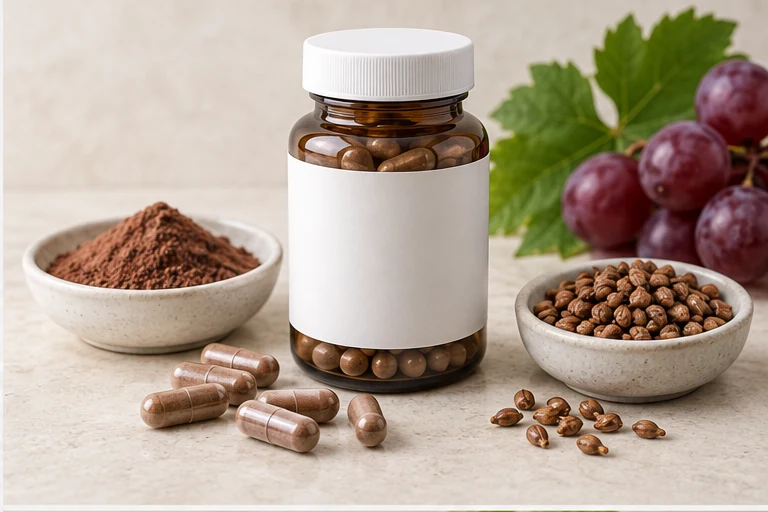
- Standardized grape seed extract capsule · Use a fingerprinted, standardized dry extract as the polyphenol ingredient
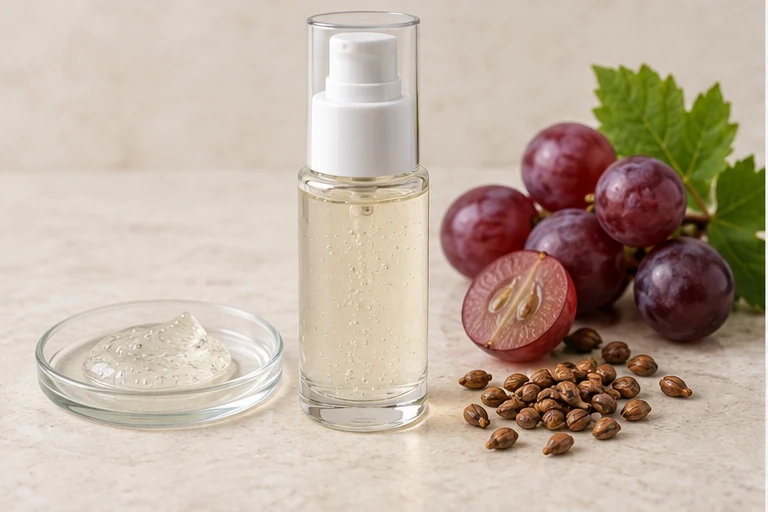
- Grape seed extract hydrating gel serum · Screen a cosmetic-grade, water-compatible seed extract as a botanical polyphenol ingredient in a simple water-glycerin gel
End-product selection
Capsules, tablets, gummies and trial beverage or emulsion formats.
Oral solids, beverage/protein systems, gummies and cosmetic development.
Three product development plans
These are pilot-development plans. Set ingredient levels and acceptance criteria for the selected market, then verify compatibility, safety and stability in the finished product.
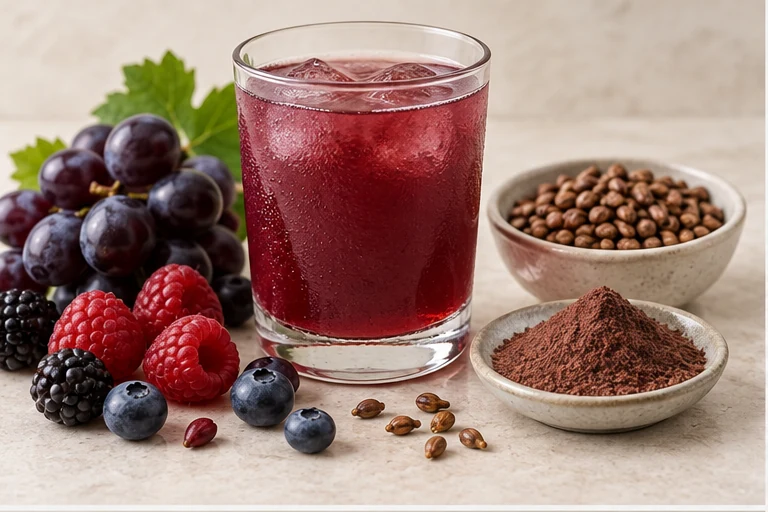
Berry-flavoured grape seed polyphenol drink
Use a supplier-qualified water-dispersible grape seed extract as the defined polyphenol input; berry flavour and a permitted sweetener build the sensory base, while citric acid adjusts acidity. Water is the vehicle. Keep added protein and mineral fortification out of the first screening batch so that any change in haze can be traced to fewer variables. Do not use grape seed oil as the polyphenol input.
Make a blank flavour base first. Separately disperse the extract in a measured portion of water, then add it slowly to the base under moderate stirring. Add diluted acid in increments, record pH and restore final batch mass with water. Compare a blank and three extract levels around the supplier-supported intended use level, recording actual milligrams per serving. Apply the intended preservation or thermal process to each candidate before making a shelf-life decision.
Compare astringency, colour, turbidity and sediment immediately, after processing and during storage at the intended and accelerated conditions. Assay marker recovery in the drink, not only in the starting powder. If clarification is required, assay before and after filtration to detect removal of the intended polyphenols. A clear day-one sample does not establish stability. Treat protein, calcium or iron addition as a separate compatibility experiment; do not promise compatibility without that test. Establish microbial controls for the finished drink independently of antioxidant assays.
Standardized grape seed extract capsule
Use a fingerprinted, standardized dry extract as the polyphenol ingredient. Microcrystalline cellulose is a proposed filler where the fill volume requires it; a small, justified amount of colloidal silica can be screened as a flow aid. Select a capsule shell through disintegration and stability testing, rather than assuming shell material is neutral. A published manufacturing study used 450 mg grape seed extract and 50 mg silica in a size 0 hard gelatin capsule; that is a documented study formulation, not a recommended dose or an instruction to copy its relatively large silica fraction.[11]
Confirm the target extract mass per capsule from the product specification and safety review. Measure bulk density before choosing capsule size. Sieve and weigh the dry materials, geometrically dilute the extract with the filler, then add the flow aid in a short final blending step. Sample multiple blender locations, fill a pilot run and sample the beginning, middle and end. Package selected candidates with a justified moisture barrier; evaluate a desiccant rather than adding one by habit.
Set both fill-mass and marker-content uniformity criteria; equal capsule weights do not prove equal polyphenol doses. Check moisture, powder flow, segregation and shell integrity after storage. Assess disintegration and a justified dissolution or release method for selected markers. The primary quality study used gallic acid, catechin, procyanidin B2 and epicatechin as grape seed capsule markers and described UHPLC-QQQ/MS quantification; this is a useful analytical starting point, not automatic method validation for a different product.[11]
Grape seed extract hydrating gel serum
Screen a cosmetic-grade, water-compatible seed extract as a botanical polyphenol ingredient in a simple water-glycerin gel. Glycerin supplies humectancy; a compatible cellulose-based thickener provides texture; a locally permitted preservative system provides microbial protection. The extract is not the emulsifier, not a substitute for preservative and not an oil-phase emollient. The extraction patent includes a dependent cosmetic-product claim, but that does not prove efficacy in this serum.[8]
Hydrate the thickener in the water-glycerin base using its supplier procedure, and prepare an extract predispersion separately. Add the extract only after the base is homogeneous and within the extract supplier’s supported temperature range. Add and distribute the preservative as its supplier specifies, adjust pH gradually, then deaerate and fill. Prepare an extract-free control and two or three extract levels within the supported cosmetic use range. Leave fragrance and extra botanicals out until the base passes compatibility screening.
Track colour, odour, pH, viscosity, visible particles and marker retention through heat/cool cycling and storage in the intended package. Compare light exposure where package choice makes it relevant. Challenge-test the final preserved formula and assess irritation and exposure before consumer testing. Any skin-benefit claim needs finished-product evidence; neither a chemical antioxidant result nor the oral clinical trial establishes skin penetration, whitening, collagen protection or sunscreen performance.
Processing and equipment
Separate oil recovery from aqueous-ethanol polyphenol recovery. Refining for a defined size profile is a different target from maximum powder yield; beverage work must assess astringency and protein haze, while capsules need profile-specific release testing.[14] [34] [52]
A useful process map is seed sorting and identity release → controlled size reduction if justified → water or aqueous-ethanol extraction → solid/liquid separation → optional enrichment and washing → solvent recovery and concentration → drying → blending and packing. This is a proposed engineering map, not a claim that every supplier follows the same route. The research extraction and the hot-water patent below use different routes and must not be merged into a purported validated operating recipe.[10][8]
Thilakarathna and Rupasinghe used 1.0 g seed samples in 50 mL tubes. Their optimized ultrasound-assisted conditions were 47% ethanol, 10:1 solvent-to-solid ratio by volume/weight, 53 minutes and 60 °C. The reported yield was 25.3 ± 1.26 mg catechin equivalents per gram fresh-weight basis, measured with a methylcellulose-precipitable tannin assay. That is a method-defined equivalent yield, not 25.3 mg of individually weighed pure OPC molecules, and not an industrial production guarantee.[10]
At pilot scale, use a screened feed system and a jacketed agitated extraction vessel with temperature measurement. An ultrasound module is an experimental option when scaling that study, not a reason to copy its minutes unchanged. Compare mixing, solids loading, energy per processed mass, temperature history and marker recovery against a non-ultrasound control. Use a centrifuge or filter sized for the actual cake and liquid; finer milling should be accepted only if the additional recovery outweighs the separation burden. These are engineering test recommendations.
Where enrichment is needed, qualify the adsorption medium and measure breakthrough, wash losses, elution recovery and cleaning performance. The hot-water patent describes dual pH treatment, enzyme treatment and an adsorbent-resin route; those particulars belong to that disclosure, not a compulsory standard for all GSE.[8] For an ethanol route, specify compatible closed solvent handling, recovery, ventilation and ignition controls through site engineering. Measure solvent residues in the dried ingredient rather than assuming evaporation removes everything.
Choose vacuum concentration and spray or vacuum drying through a mass balance and stability trial. Track dry solids, total phenolic assay and chromatographic markers separately across every major step. If a drying carrier is used, declare it and correct the assay basis; a change in percentage can reflect dilution rather than chemical loss. Set dryer conditions from outlet/product behaviour, moisture and recovery data, not from the laboratory extraction temperature.
Quality and safety
For each incoming lot, propose an identity fingerprint against authenticated grape seed material, a method-defined potency result and a declared carrier/solvent history. Add risk-based tests for moisture, microbial load, relevant pesticides, elemental contaminants and residual solvents with limits chosen for the market and product category. Where adulteration is a concern, use a targeted screen as well as the main assay. The 2015 primary study shows why a total-polyphenol result alone cannot settle identity.[20]
The marker panel must fit the intended comparison. A chromatogram can distinguish size fractions that a colourimetric result cannot; capsule quality work also shows how multiple small-molecule markers can be quantified.[2][11] Validate sample extraction and recovery in the actual beverage, capsule or serum. Include an extract-free matrix blank to reveal interference, then follow the same markers during storage.
Agree acceptance criteria before the stability study starts. A drink needs sensory, sediment, analytical and microbiological criteria; a capsule needs uniformity, release and package-protection criteria; a serum needs viscosity, appearance, preservative performance and skin-safety criteria. These tests answer different questions. A large antioxidant-assay value cannot compensate for failed identity, poor release or microbial growth.
Buy this ingredient: specifications, COA, certification documents & pricing →
Practical questions
Is grape seed oil a cheaper substitute? No. This article specifies a polyphenol extract and its fingerprint, whereas seed oil is a different ingredient stream. Do not transfer extract marker assays or clinical results to an oil product merely because both come from seeds. The primary manufacturing paper treats the polyphenol materials as compositionally defined preparations.[11]
Does “95% OPC” mean better performance? Not without knowing the assay, calibration and oligomer definition. The methods comparison showed that size distribution needs a suitable separation method; a single colourimetric number is not enough.[2] Choose a grade by the finished-product brief and verified profile, not by the largest printed percentage.
Can a capsule formula be poured straight into a drink? Treat that as a new formulation. A published capsule contained silica and a gelatin shell, while its quality programme measured capsule-specific uniformity and release.[11] For a drink, select a suitable ingredient form and verify taste, sediment, marker recovery and preservation again.
Can the ingredient support a blood-pressure or anti-ageing promise? The oral trial studied one specified extract and did not show uniform superiority across its overall analysis and sex subgroups.[15] The evidence assembled here contains no finished-serum efficacy trial. Keep a formulation concept separate from a substantiated consumer claim.
Research cases
| Research | Material/scale | Finding and use |
|---|---|---|
| 2022 extraction optimization | Mixed commercial seeds/powder; 1 g in 50 mL tubes | Heated ultrasound reduced time/solvent needs under specified conditions; process-screening starting point[14] |
| Biological work within that paper | Sugar-free research fraction; palmitate-treated AML12 mouse hepatocytes | Reduced ROS/lipid accumulation; mechanistic cell evidence, not human weight-loss or fatty-liver treatment evidence[14] |
| 2000 analytical comparison | Grape-seed extracts/products; retrieved abstract lacks total sample count | Colorimetry and HPLC answer different questions; useful for specification design[52] |
| 2015 commercial authentication | 21 products and authenticated seed/peanut-skin/pine-bark comparators | Nine contained peanut-skin adulteration; supports orthogonal identity controls[33] |
| 2021 clinical-supply CMC study | Separate seed capsules, resveratrol capsules and grape juice | Uniformity/profiles/stability framework, not a clinical-efficacy result[34] |
A manageable next matrix combines two feedstocks, intact/coarsely broken states and conventional/ultrasound contact with matched thermal histories. Advance two routes to full-stream recovery and size-profile comparisons, then to protein-beverage and capsule testing. The resulting educational content can explain why equal total-polyphenol powders behave differently, instead of presenting chemical radical-scavenging rankings as clinical rankings.
Relevant patents
US6544581B1
B1 issued US patent. Original applicant/assignee: Canandaigua Wine Company, Inc.. Priority / filing / publication: 1999-06-22 / 2000-06-22 / 2003-04-08.[8]
Claim 1 covers a grape-seed polyphenol extraction process using water at about 140–212 °F followed by dual pH treatment. Claim 2 adds acidification to pH 1.5–2.5, pectolytic enzyme treatment and adsorbent resin; claim 5 specifies basification to pH 4.0–6.0. These are claim limitations, not merely the title. Claims 12–15 tie food, beverage, cosmetic and supplement products to the extract of claim 11.[8]
Relevant to seed-polyphenol manufacture and downstream product forms, not to oil pressing. It illustrates why clarification, pH history and resin qualification belong in a process review. It does not validate the three editorial formulations above.[8]
US7767235B2
B2 issued US patent. Original applicant/assignee: Constellation Brands, Inc.. Priority / filing / publication: 2005-09-28 / 2006-09-27 / 2010-08-03.[9]
Claim 1 defines a grape polyphenol extract by about 5–15% monomers, 5–20% dimers, 3–10% trimers, 2–10% tetramers and 2–10% pentamers by weight, with about 2% or less epicatechin-gallate terminal units. Claim 9 adds a pharmaceutically acceptable excipient to the defined extract; claim 17 concerns a food or beverage comprising that composition. This is a composition-focused granted claim set, not a general claim to every grape seed product.[9]
The description includes grape seed extraction, so the document is relevant to a grape seed polyphenol article even though claim 1 says grapes rather than seeds exclusively. It makes oligomer distribution and galloylation relevant procurement questions. Its family is distinct from the 1999-priority extraction family above.[6][9]
References
- Grape seed proanthocyanidins: extraction study (2000) · 2026-09-11
- US6544581B1 · 2026-09-11
- US7767235B2 · 2026-09-11
- Grape seed proanthocyanidin extraction study (2022) · 2026-09-11
- Characterization of grape-derived materials prepared for a clinical trial (2021) · 2026-09-11
- Grape seed extract and blood pressure: randomized trial (2021) · 2026-09-11
- https://www.ebi.ac.uk/europepmc/webservices/rest/search?query=EXT_ID%3A25306345&format=json&resultType=core · 2026-09-11
- US6544581B1 issued patent primary PDF · 2026-09-11
- US7767235B2 issued patent primary PDF · 2026-09-11
Material and processing background sources
- Optimization of the Extraction of Proanthocyanidins from Grape Seeds Using Ultrasonication-Assisted Aqueous Ethanol and Evaluation of Anti-Steatosis Activity In Vitro - PMC · 2026-09-09
- Chemical investigation of commercial grape seed derived products to assess quality and detect adulteration · 2026-09-09
- Chemical, Manufacturing, and Standardization Controls of Grape Polyphenol Dietary Supplements in Support of a Clinical Study: Mass Uniformity, Polyphenol Dosage, and Profiles · 2026-09-09
- A Comparison of Methods For Quantifying Oligomeric Proanthocyanidins From Grape Seed Extracts | American Journal of Enology and Viticulture · 2026-09-09