Material identity
Ginkgo biloba leaves; leaf powder, refined leaf extract, seed kernels and outer seed coats are different materials.
Ginkgo biloba L. leaf powder, crude leaf extract, refined quantified dry leaf extract and seed material are not interchangeable.[13] The 2015 EMA monograph specifies dry extract DER 35–67:1 with acetone 60% m/m as extraction solvent for its well-established medicinal use.[13] That solvent specification describes extraction, not the intended residual acetone concentration in a finished product.[13]
A 2018 analytical study describes pharmacopoeial dry extract as 22.0–27.0% flavonoids and 5.4–6.6% terpene lactones, and measures ginkgolides A, B, C and bilobalide separately.[2] The familiar “24/6” shorthand refers to constituent groups; it is not a complete specification, an authenticity test or proof of equivalence to the extract in a clinical trial.[2]
Specify plant part, extraction/refining history, carrier fraction, assay method and dry/as-is basis in the purchase contract.[7][13] Use the current applicable pharmacopoeial edition and destination law for release limits; this article does not certify a current global monograph.[7][13] Patented high-lactone extracts described later are chemically different development materials, not substitutes selected by matching total extract mass.[7][13]
Effects and human research
In the GEM randomized double-blind trial, 3,069 adults aged at least 75 years with normal cognition or mild cognitive impairment received ginkgo extract 120 mg twice daily or placebo for a median 6.1 years.[3] All-cause dementia was not reduced: hazard ratio 1.12, 95% CI 0.94–1.33.[3] Alzheimer disease incidence was also not reduced.[3] The dose is a trial description, not advice for a food or supplement serving.[3]
EMA accepts well-established medicinal use for the specified preparation and indication, whereas NCCIH’s February 2025 synthesis says dementia symptom benefit may be modest but evidence is inconsistent, and healthy-person cognitive benefit is uncertain.[1][10][13] The negative prevention trial does not answer the same question as treatment of existing symptoms.[1][10][13]
Mechanistic descriptions of blood flow, platelet activity or oxidative pathways cannot replace a clinical endpoint.[10][13] EMA states that the exact mechanism is not known.[10][13] Do not turn a chemical antioxidant assay, ingredient standardization or a patent’s therapeutic claim into a promise to prevent dementia, treat tinnitus or improve every adult’s memory.[10][13]
Material forms and composition
Flavone glycosides, individual terpene lactones and unwanted ginkgolic acids need separate analytical controls.
Flavone glycosides, individual terpene lactones and unwanted ginkgolic acids need separate analytical controls.
| Equipment options | Selection principle | Failure variables | Evidence status |
|---|---|---|---|
| Jacketed stirred vessel / percolation bed | Mixing and thermal control versus concentration-gradient operation | Dead zones, short circuits, compressed bed; solvent concentration and cake assay | Engineering options built around documented solvent extraction[2][4] |
| Decanter/disc centrifuge / filter | Sedimentation versus particle interception; balance clarity and solute loss | Fine-particle carryover, wet-cake loss, cleaning; throughput and turbidity | Centrifugation is documented; detailed selection is proposed[4] |
| Adsorption resin columns | Selective adsorption and solvent elution | Competitive loading, channeling, regeneration; bed volumes, contact time, breakthrough | Documented applicant process, not pharmaceutical equivalence[4] |
| Vacuum evaporator / spray dryer | Solvent removal versus droplet-to-powder formation | Foaming, entrainment, nozzle fouling, wall residence, residual solvent | Sequence documented; engineering controls proposed[4] |
| Magnetic particles plus preparative HPLC | Salicylate binding to Fe(III), followed by homologue separation | This isolates acids as research materials; it is not validated food production detoxification | Original laboratory separation; input mass unavailable in retrieved abstract[21] |
| Test | What it answers | What it cannot establish alone | QA transfer requirement |
|---|---|---|---|
| Post-hydrolysis HPLC-UV | Converted glycoside total under a defined method | Native glycoside structure or absence of enrichment | Hydrolysis recovery, factors, standards, moisture basis[2] |
| Native fingerprint/free aglycones | Unusual enrichment and external-flavonoid patterns | Every possible adulteration | Authenticated comparator lots and orthogonal profiles[2] |
| Individual A/B/C and bilobalide | Lactone content and distribution | Flavonoid authenticity or acid control | Weak UV response makes detector selection important; the study used LC-MS/MS and discusses historical RI testing[2] |
| Ginkgolic-acid homologues | Low-level unwanted-constituent control | “Not detected” below every conceivable limit | Sum definition, LOQ, matrix recovery, units; 5 ppm equals 5 mg/kg by unit conversion[2][21] |
| Botanical identity/carrier balance | Leaf versus extract versus diluted powder | Dosage-form release | Traceability, part, carrier fraction and finished-product linkage |
| Research type | Material/scale | Finding and useful interpretation |
|---|---|---|
| Original market-quality study, 2018 | 11 illustrative supplements plus one medicine control from a larger purchase pool | Detects mismatched marker groups, foreign aglycones and leaf powder in place of extract; supports orthogonal identity testing[2] |
| EFSA assessment, 2021 | Proposed cat/dog feed ingredient; industrial batch size undisclosed | Documents process while finding characterization/safety inadequate; publication of a route is not approval[4] |
| Original separation study, 2014 | Petroleum-ether leaf extract, methanol, magnetic particles; abstract lacks input mass | Supports acid chemistry/reference preparation, not commercial detoxification validation[21] |
| GEM randomized double-blind trial | 3,069 adults ≥75; 120 mg extract twice daily; median 6.1 years | No reduction in overall dementia or Alzheimer incidence; prevention and symptomatic improvement are different endpoints[46] |
| EMA synthesis | Specific leaf preparations and clinical/traditional-use evidence | Supports preparation- and indication-specific organization of evidence[28] |
Application selection
The strongest starting point is a defined, refined leaf extract in an adult oral product, with the market category settled before formulation.[1][13] EMA distinguishes a specific dry leaf extract used medicinally for age-associated cognitive impairment and quality of life in mild dementia from powdered leaf used traditionally for minor circulatory symptoms.[1][13] These are preparation-specific conclusions, not permission to market any ginkgo product for memory loss.[1][13]
For R&D, prioritize a capsule when the goal is traceable extract delivery, a tablet when compact packaging and repeatable release justify compression development, and a measured oral suspension only when liquid dosing has a clear use case.[1][10][13] These are proposed development routes, not tested commercial formulas.[1][10][13] No ordinary beverage, leaf tea, seed snack or universal food fortification recommendation follows from the medicinal evidence.[1][10][13]
- Single-extract capsule · Bench proposal only: a 300 mg fill containing 120 mg qualified extract, 174 mg microcrystalline cellulose, 3 mg colloidal silica and 3 mg magnesium stearate, excluding the shell
- Immediate-release coated tablet · Bench proposal only: a 300 mg core containing 120 mg qualified extract, 150 mg microcrystalline cellulose, 24 mg croscarmellose sodium, 3 mg colloidal silica and 3 mg magnesium stearate; coating mass is additional
- Measured oral suspension, not a beverage · Bench proposal only, not for human use before safety and legal clearance: 2
End-product selection
Capsules and tablets; liquid combinations only as separately assessed development concepts.
Defined oral dosage-form development; beverage suitability is a separate solubility and safety question.
Three product development plans
These are pilot-development proposals. Ingredient roles, addition order and acceptance tests must be qualified in the final product.
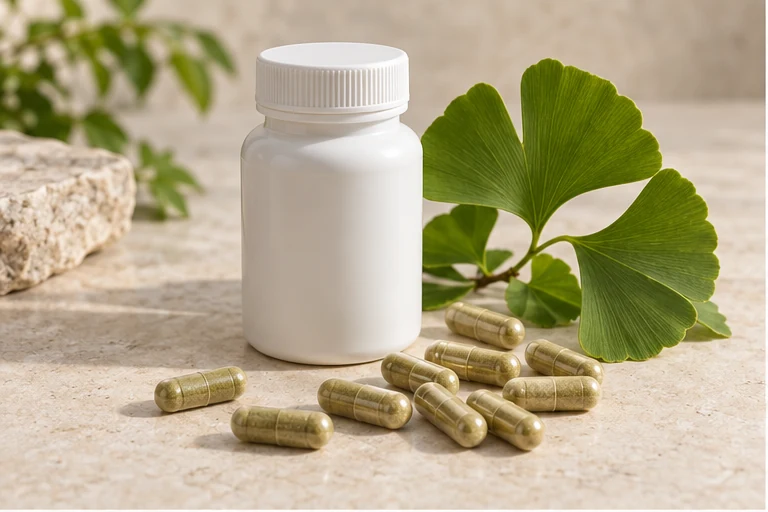
Single-extract capsule
Bench proposal only: a 300 mg fill containing 120 mg qualified extract, 174 mg microcrystalline cellulose, 3 mg colloidal silica and 3 mg magnesium stearate, excluding the shell. This is a mass-balance starting point, not a recommended serving or validated formula.
Extract supplies the declared botanical; cellulose sets fill volume; silica is a flow aid; stearate is a lubricant. Sieve and assay the extract, geometrically preblend with cellulose, add silica, add lubricant last with limited mixing, then encapsulate and pack in a moisture-barrier system.
Test tapped density before shell sizing; sample beginning/middle/end fills for both marker groups, not weight alone. Compare disintegration and marker release, moisture uptake and stability. Reject segregation or over-lubrication that changes release. Use only excipients permitted for the chosen category.
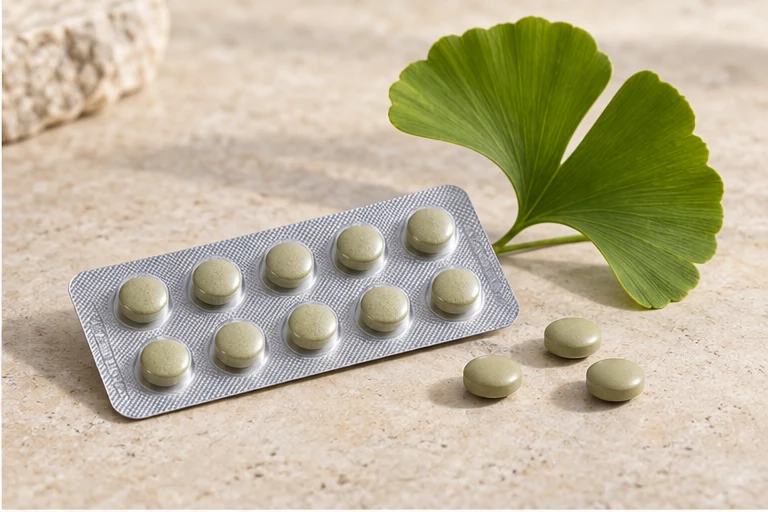
Immediate-release coated tablet
Bench proposal only: a 300 mg core containing 120 mg qualified extract, 150 mg microcrystalline cellulose, 24 mg croscarmellose sodium, 3 mg colloidal silica and 3 mg magnesium stearate; coating mass is additional. Start with direct compression and compare dry granulation only if flow or compactability fails.
Cellulose supports compaction; croscarmellose is the disintegrant. Preblend extract and filler, distribute disintegrant and glidant, lubricate briefly, compress across a controlled force range, then screen a thin immediate-release coating for taste and handling. Coating is not assumed to improve bioavailability.
Measure tensile strength, friability, disintegration and dissolution of both flavonoids and lactones across compression forces. Track coating exposure, impurity profiles and packaged stability. Stop if mechanical strength is gained at the cost of release; tablet hardness alone is not the endpoint.
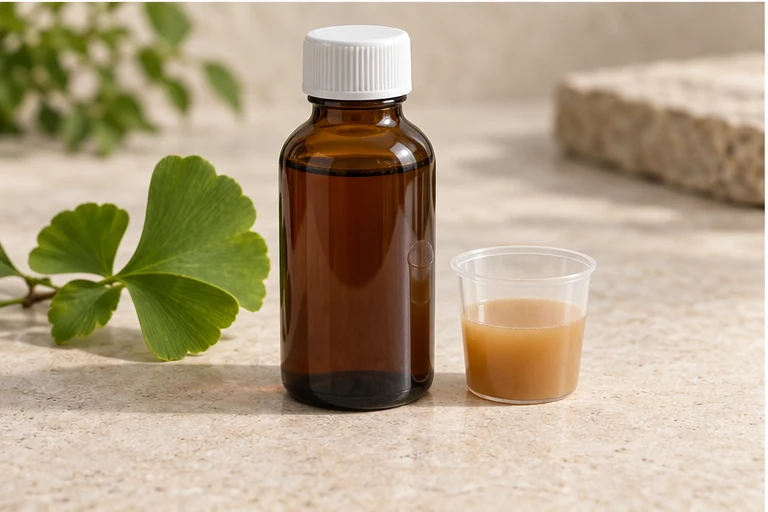
Measured oral suspension, not a beverage
Bench proposal only, not for human use before safety and legal clearance: 2.4 g qualified extract per 100 mL final volume, equivalent by arithmetic to 120 mg per 5 mL. Screen glycerol at 5 g/100 mL for wetting and xanthan gum at 0.10–0.25 g/100 mL for suspension, with purified water to volume. These levels are screening choices, not published efficacy or preservation data.
Prewet extract in glycerol; hydrate gum separately in water; combine under controlled shear, adjust to final volume, deaerate and fill. Screen pH 4, 5 and 6 rather than declaring an optimum. Select any buffer, sweetener and preservative only after legal and compatibility review. A single-dose prototype can separate early physical screening from multi-dose preservation development.
The EFSA applicant’s extract was only partly soluble, so distinguish a suspension from a clear solution.[4] Test sedimentation, redispersibility, viscosity, delivered-dose uniformity after realistic shaking, marker recovery after cold storage and heat exposure, container sorption and microbial challenge for any multi-dose product. Do not clear the liquid by filtration without checking lost markers.
Processing and equipment
A refined quantified leaf extract needs selective unwanted-constituent removal alongside marker enrichment. Simple leaf extraction or leaf-polysaccharide research cannot substitute for that route. Solid dosage forms then need uniformity and release tests.[2] [28]
An EFSA assessment documents one applicant’s ethanol extraction at 30°C, centrifugation, resin adsorption and ethanol elution, evaporation, spray drying, then maltodextrin addition, milling and sieving.[4] EFSA could not establish safety for that proposed cat/dog feed use because characterization and supporting data were inadequate.[4] The process is a documented example, not evidence that every ethanol/resin extract equals a medicinal extract.[4]
Proposed engineering control: receive authenticated leaf lots and measure moisture before charging a jacketed extraction vessel. Record actual solvent composition, temperature and contact time. Choose filtration or centrifugation using clarity and marker loss in wet solids, not throughput alone. A resin column needs feed loading, breakthrough and elution-cut assays; a vacuum evaporator needs solvent recovery and carryover controls; a spray dryer needs feed-solids, outlet-temperature and powder-recovery records. These equipment choices require pilot verification, not an assumed production recipe.
Keep separate balances for flavonoids, each lactone and unwanted constituents across feed, waste and product pools.[6][7] Calculate recovery against incoming constituent mass and final assay against marketed powder mass including carrier.[6][7] Use explosion-protected solvent handling and validated cleaning as engineering requirements.[6][7] The historical patents below explain selective refining but are not modern food-safe operating instructions.[6][7]
Quality and safety
For the specific dry extract, EMA lists pregnancy as a contraindication, does not recommend use during lactation, and warns about bleeding tendency, anticoagulants and antiplatelet medicines.[13] It advises discontinuation 3–4 days before surgery as a precaution and notes that further seizures in people with epilepsy cannot be excluded.[13] Individual medication and surgical decisions require the treating clinician.[13]
NCCIH reports dizziness, gastrointestinal symptoms and headache among common adverse effects.[10] Fresh seeds are toxic when eaten, and serious adverse effects have also occurred after roasted seeds or crude plant material.[10] Low ginkgolic-acid content in a refined leaf extract does not establish seed safety or remove all interaction risks.[10]
In the EU, the HMPC monograph informs national medicinal licensing; it is not a blanket authorization for foods.[1][11] In the United States, supplements are not FDA-approved before sale, must meet applicable manufacturing and labeling requirements, and cannot claim to diagnose, treat, cure or prevent disease as supplements.[1][11] A liquid’s presentation matters: representing it as a conventional beverage is not the same as labeling and selling a dietary supplement.[1][11]
Confirm the exact extract’s eligibility, permitted presentation and claims in each destination market before human-use testing or sale. The proposals below assume neither China food/health-food approval nor EU food eligibility. Those routes require a separate material-specific authorization review. In the United States, assess any new-dietary-ingredient notification requirement and the applicable supplement or beverage rules.[11]
The 2018 market investigation used modified pharmacopoeial HPLC-UV for flavonoids, LC-MS/MS for terpene lactones and microscopy for some leaf samples.[2] It found selected examples of under/over-declaration and undeclared external materials.[2] The abstract supports the existence of adulteration patterns, not a prevalence estimate for the entire European market.[2]
Proposed release panel: botanical/preparation identity; native chromatographic fingerprint plus method-defined flavonoid assay; individual ginkgolides and bilobalide; ginkgolic-acid homologues; residual solvents; moisture; relevant elemental, pesticide and microbial contaminants; and finished-dose uniformity and release. Set each limit and method in the applicable product specification. An “ND” result is meaningful only with the detection/quantification limit, matrix recovery and summed-analyte definition. A 5 mg/kg ginkgolic-acid purchasing target, if adopted, must be justified for the exact material and verified method; it is not asserted here as universal food law.
For US supplements, 21 CFR 111.70 requires specifications for component identity, purity/strength/composition as necessary, contamination limits and relevant in-process and finished-product controls.[9] Transfer methods with split samples, standards, chromatograms and calculation rules rather than accepting a COA title such as “HPLC” as the method.[9]
EMA does not recommend combining ginkgo preparations with efavirenz. Ask the treating clinician or pharmacist to review the exact product and medicines, including any planned surgery.[13]
Buy this ingredient: specifications, COA, certification documents & pricing →
Practical questions
Does 24/6 mean the extract works?[2][3] No.[2][3] Composition helps define material; GEM still found no dementia-prevention benefit at its tested extract regimen.[2][3]
Can leaf tea or seed powder replace the refined extract?[10][13] No evidence reviewed here establishes that substitution.[10][13] EMA separates powdered leaf from refined extract, and NCCIH warns that seeds and crude plant material can cause serious adverse effects.[10][13]
Is an aqueous dispersion automatically a soluble extract?[4] No.[4] One documented extract was partly soluble.[4] Confirm physical state and delivered dose; clarity after filtering does not establish marker retention.[4]
Can “supports memory” be used without review?[10][11] No.[10][11] US structure/function claims need substantiation and applicable labeling requirements; the uncertain healthy-person evidence should constrain wording.[10][11] A disclaimer cannot turn a disease-treatment claim into a permissible supplement claim.[10][11]
Research cases
Case 1, clinical decision: GEM tested prevention over years and found no reduction in incidence.[3] A brand brief based on this trial should remove dementia-prevention language rather than reinterpret the result as evidence for a different population.[3]
Case 2, supplier decision: the analytical market study found multiple falsification patterns.[2] Proposed action is to quarantine a suspect lot and compare orthogonal identity and quantitative methods before accepting or rejecting it; this is a suggested response, not a claim that a specific supplier failed our testing.[2]
Case 3, separation research: a 2014 study used Fe3O4 magnetic nanoparticles and preparative chromatography to enrich and isolate ginkgolic acids.[5] The retrieved abstract describes acid enrichment, including a 73% acid fraction; that is research-material purification, not demonstration of detoxified ingestible extract manufacture.[5] Do not market a conventional extract as “nanoparticle detoxified” on this evidence.[5]
Relevant patents
EP0431535
A1 published application; not a current legal-status opinion. Original applicant/assignee: Dr Willmar Schwabe GmbH & Co KG. Priority / filing / publication: 1989-12-04 / 1990-12-03 / 1991-06-12.[6]
Claims 1–2 composition; claims 3–5 selective refining; claim 6 pharmaceuticals.[6]
Low-alkylphenol refining with lactone retention.[6]
CA2443302
A1 published application; not a current legal-status opinion. Original applicant/assignee: Original applicant unconfirmed; original-assignee field: Individual. Priority / filing / publication: 2001-04-10 / 2002-04-09 / 2002-10-24.[7]
Claim 1 sequential solvent process; claim 2 no chromatography; claims 10 and 12 distinct enriched compositions.[7]
Composition changes require new comparability work; not interchangeable with conventional 24/6 extract.[7]
References
- Ginkgo folium - herbal medicinal product | European Medicines Agency (EMA) · 2026-09-11
- Ginkgo adulteration study · 2026-09-11
- GEM dementia prevention trial · 2026-09-11
- EFSA ginkgo feed assessment · 2026-09-11
- Efficient Purification of Ginkgolic Acids from Ginkgo biloba Leaves by Selective Adsorption on Fe3O4 Magnetic Nanoparticles · 2026-09-11
- EP0431535A1 - Extract from Ginkgo biloba leaves, its method of preparation and pharmaceuticals containing the extract · 2026-09-11
- CA2443302A1 - Method for preparing an extract of ginkgo biloba leaves highly enriched in active principles · 2026-09-11
- CA2031385C formulation examples; same family as EP0431535A1 · 2026-09-11
- 21 CFR 111.70 -- What specifications must you establish? · 2026-09-11
- https://www.nccih.nih.gov/health/ginkgo · 2026-09-11
- https://www.fda.gov/food/information-consumers-using-dietary-supplements/questions-and-answers-dietary-supplements · 2026-09-11
- https://www.ema.europa.eu/en/documents/herbal-monograph/final-european-union-herbal-monograph-ginkgo-biloba-l-folium_en.pdf · 2026-09-11
Material and processing background sources
- Ginkgo biloba Food Supplements on the European Market - Adulteration Patterns Revealed by Quality Control of Selected Samples · 2026-09-09
- Safety and efficacy of a feed additive consisting of a dried extract from the leaves of Ginkgo biloba L. (G. biloba dry extract) for use in cats and dogs (C.I.A.M.) · 2026-09-09
- Efficient Purification of Ginkgolic Acids from Ginkgo biloba Leaves by Selective Adsorption on Fe3O4 Magnetic Nanoparticles · 2026-09-09
- Ginkgo folium - herbal medicinal product | European Medicines Agency (EMA) · 2026-09-09
- Ginkgo biloba for Prevention of DementiaA Randomized Controlled Trial · 2026-09-09