Material identity
Centella asiatica herb; the cited laboratory experiment used authenticated mature leaves, not an unspecified whole-plant commercial powder.
Centella asiatica, also called gotu kola, provides chemically different ingredients: leaf or aerial-part extracts, refined triterpenoid fractions and isolated compounds. Asiaticoside and madecassoside are glycosides; asiatic acid and madecassic acid are their corresponding aglycones. Equal total triterpenoid values can conceal different proportions of these components and different formulation behaviour.[4][19]
For skincare, select the extract around the finished serum or emulsion, not the plant name alone. For a prepared water/glycol ingredient, check the carrier composition and any declared preservative; an enriched dry powder may need a different solvent or dispersion route. Traditional edible-leaf use does not establish that a refined cosmetic ingredient is suitable for a beverage.[4]
Effects and human research
EMA’s 2022 assessment distinguishes traditional cutaneous use of comminuted or powdered herb as an aid to healing minor wounds from well-established clinical efficacy. The reviewed wound studies showed a trend of benefit, but small samples, methodological problems and incomplete extract descriptions prevented a well-established-use conclusion. A cosmetic moisturizer therefore needs its own skin-use evidence; the herbal indication is not a wound-healing claim for a serum.[4]
A 2017 systematic review examined oral Centella preparations for cognition and mood. It included five randomized trials of Centella alone and six of Centella-containing products. Meta-analysis found no significant difference from placebo across cognitive domains. Signals in alertness and anger scores did not establish a general memory benefit, and mixed products cannot identify Centella’s independent contribution.[16]
EMA did not include oral therapeutic use in its monograph, citing potential fertility and liver-safety concerns alongside the availability of other therapeutic options. This is a medicinal assessment, not a worldwide food ban. For topical products, allergic contact reactions remain relevant, including reactions to other formula ingredients; “sensitive skin” positioning needs finished-product tolerability testing.[4]
Asiaticoside, madecassoside and their aglycones
Calculate four-marker contributions to a formula →
Asiaticoside and madecassoside are glycosides; asiatic acid and madecassic acid are aglycones. Their distributions matter beyond a total-triterpene number.
| Form | Composition | Formulation consequence |
|---|---|---|
| Broad leaf/aerial-part extract | Solvent-extractable triterpenoids plus other constituents.[4][19] | Colour, odour and non-target solids may determine serum appearance. |
| Prepared water/glycol liquid | Native extract diluted in a declared vehicle. | Calculate the native extract and marker content, not the full solution mass. |
| Refined triterpenoid fraction | A defined mixture, sometimes involving conversion or selective purification.[4][11] | Specify each marker; “total triterpenoids” does not establish TECA/TTFCA equivalence. |
| Isolated glycoside or aglycone | Madecassoside, asiaticoside or a defined acid rather than the whole extract.[4][19] | Qualify identity, purity and solubility separately; do not substitute by equal mass. |
Application selection
Topical formulation development; oral and medicinal uses need separate assessment.
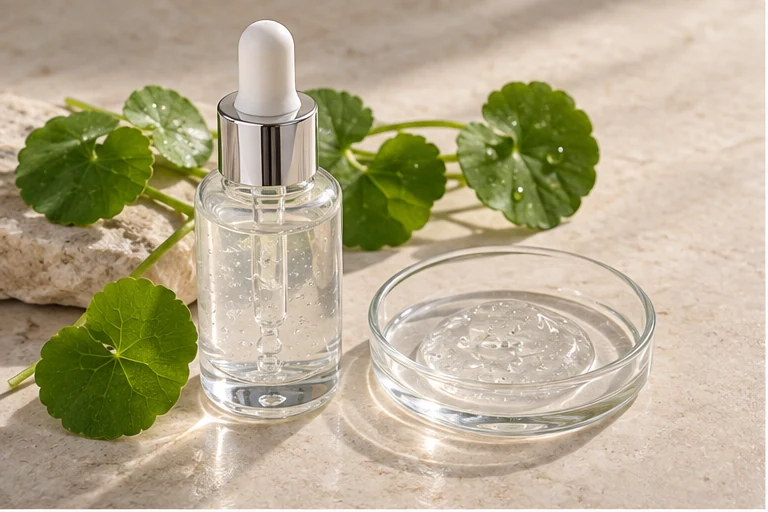
- Centella humectant serum · Combine a composition-defined water/glycol Centella ingredient with glycerol, panthenol and a compatible gel former
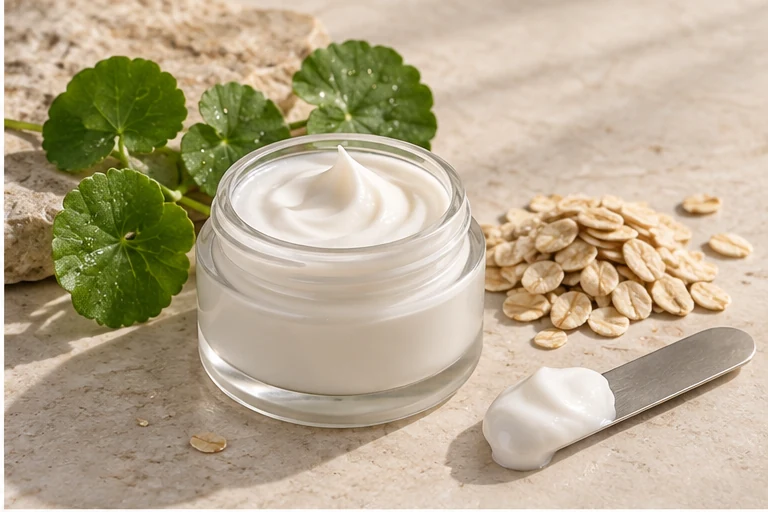
- Centella oat and ceramide cream · Pair a characterized Centella fraction with an oat ingredient, a ceramide preparation and an oil-in-water cream base
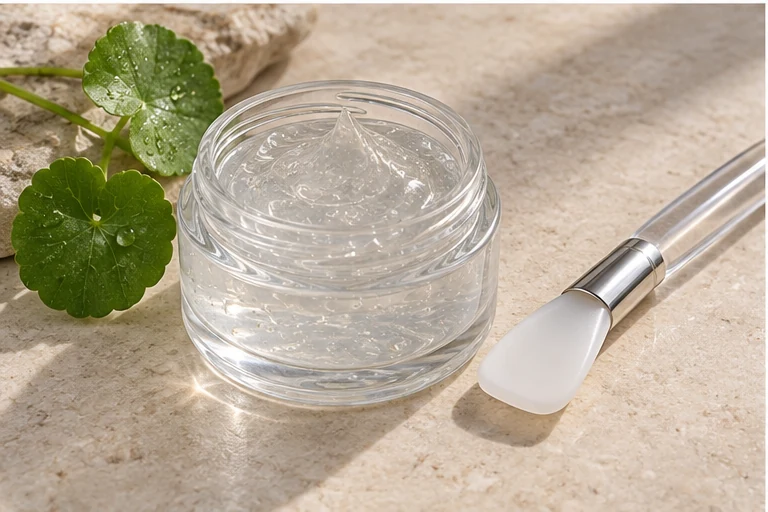
- Centella rinse-off gel mask · Combine a compatible broad Centella liquid extract with glycerol and a washable hydrocolloid gel base
End-product selection
Serums, hydrogels, creams and emulsions as development concepts, not wound treatments.
Topical formulation development; oral and medicinal uses need separate assessment.
Three product development plans
These are pilot-development proposals. Ingredient roles, addition order and acceptance tests must be qualified in the final product.
Centella humectant serum
Combine a composition-defined water/glycol Centella ingredient with glycerol, panthenol and a compatible gel former. Glycerol and panthenol contribute humectant functionality; the polymer sets flow and skin feel. Centella is the botanical component, not a substitute for the preservation system.
Prewet the polymer if its grade requires it, hydrate in the water phase, and dissolve the compatible humectants separately. Dilute the Centella ingredient into a small part of the base, add under moderate mixing, then set final pH and viscosity. Introduce the preservative according to its temperature and pH requirements rather than assuming the incoming extract preserves the batch.
Look for cold-storage crystals, delayed haze, stringiness and colour drift. Assay the four triterpenoid markers in the prepared serum and examine any sediment. Follow with preservative-challenge and package-compatibility testing, then a human-use assessment of the specific comfort or hydration claim. Solvent selectivity in the extraction study explains why total extract concentration alone is an inadequate compatibility guide.[19]
Four-marker mass contribution calculator
Compare powders and liquid ingredients using the composition of the material actually weighed into the formula. Calculate each component’s theoretical contribution to the final formula. No complete formula is needed; inputs stay on this page and are not saved or sent.
Enter each component’s content by mass in the whole material as supplied; water, solvent and carrier are included in the denominator. Leave unknown, not-detected or below-quantification results blank and retain the report wording in the worksheet; enter 0 only for a confirmed numeric zero. Do not enter dry-basis values, peak-area percentages or mg/mL.
Theoretical final contribution
Theoretical final contribution
Theoretical final contribution
Theoretical final contribution
Theoretical final contribution
Enter known values and select the as-supplied basis to calculate; blank fields remain unknown.
Formulas and accounting boundaries
- 1% w/w = 10 mg/g. For as-supplied content C (mg/g) and addition A (% w/w): theoretical final concentration (mg/g) = C × A ÷ 100; final mass percent = that result ÷ 10.
- Arithmetic example only, not a measurement or recommended use level: if a supplied ingredient contains 20 mg/g of a component and makes up 1% w/w of the final formula, that component contributes a theoretical 0.2 mg/g, or 0.02% w/w. The denominator is final formula mass, not the base mass before addition.
- Do not multiply a dry-basis assay directly by the addition rate of an as-supplied ingredient. First convert it to as-supplied content using traceable data consistent with that material and its assay basis. Loss on drying is not automatically water content, and an as-supplied assay should not have carrier deducted again. Without confirmed density, do not convert mL to g.
- Use the fifth row for one carrier or preservative at a time; do not fill unknown composition with zero. The four markers do not represent all extract constituents or native solids, and their sum does not establish TECA equivalence. No total-active value is reported here.
- Results describe only the theoretical contribution from this ingredient, not measured final content, process recovery, solubility, stability, tolerability or preservative efficacy. Account separately for contributions from other ingredients. Record final-product measurements, method and sampling time separately; this tool does not infer efficacy or safe use levels. Displayed values use up to six significant digits, not assay precision.
Download blank accounting worksheet (TXT)
Dry-basis versus as-received assays · Carriers and native extract content · Centella supply specifications and samples
Centella oat and ceramide cream
Pair a characterized Centella fraction with an oat ingredient, a ceramide preparation and an oil-in-water cream base. The lipid system supplies emollience and structure; oat and Centella are distinct botanical components. A published patent specifically combines selected Centella triterpenes, oat, ceramide and a lipid-bilayer structurant, providing a formulation precedent rather than clinical proof for any new cream.[12]
Prepare the oil phase and the hydrated aqueous phase separately. Incorporate the ceramide preparation in the phase specified for its actual commercial form, emulsify, then cool under controlled mixing. Add a compatible pre-dissolved Centella ingredient at a temperature supported by its stability data. Oat oil belongs in the oil phase; colloidal oatmeal and water-based oat extracts cannot be treated as the same ingredient.
Evaluate emulsion droplet growth, separation, graininess and crystallization through heating/cooling cycles and storage. Track viscosity recovery after shear, four-marker recovery, preservative efficacy and package dispensing. Compare with the same cream base without Centella to distinguish a botanical contribution from the moisturization provided by the base.
Centella rinse-off gel mask
Combine a compatible broad Centella liquid extract with glycerol and a washable hydrocolloid gel base. A slightly botanical tint can be acceptable here, reducing the need to select a highly purified fraction merely for a colourless appearance. Glycerol contributes humectancy, while the gel controls spread and contact during use.
Hydrate the gel former fully before adding the extract. Introduce the extract as a diluted premix, then adjust pH and final solids while checking gel strength. Deaerate gently and fill in a package suited to repeated wet-hand use or a single-use format. Keep the preservation system designed for the finished water-rich mask.
Test spreading, rinse-off residue, tack, syneresis and viscosity after storage. Confirm microbial robustness and recovery of the intended markers, and assess skin tolerance under the actual contact-and-rinse protocol. Do not use minor-wound medicinal evidence to support use on damaged skin.[4]
Extraction of Centella asiatica: solvent choice and triterpenoid profile
A broad liquid extract and a glycoside-rich clear serum need different fractionation and colour-control targets. Enriching an aglycone changes dispersion requirements. The methanol laboratory screen is not a food or cosmetic manufacturing recipe.[3] [4]
The extraction route should follow the intended Centella ingredient. A broad leaf extract, a glycoside-rich fraction and an isolated triterpenoid do not have the same composition. Track asiaticoside and madecassoside separately from asiatic acid and madecassic acid when comparing solvents and purification steps. A higher crude-extract yield does not by itself mean a higher recovery of every marker; laboratory extraction conditions are not finished-product specifications.[4][19]
Broad extracts begin with authenticated leaves or aerial parts, controlled drying and milling, solvent contact, solid–liquid separation and concentration. The extraction vessel controls wetting, temperature and contact time; a centrifuge or filter removes tissue. Finer milling can accelerate release but increase fines and filtration resistance. Solvent selection must follow the desired glycoside/aglycone profile.[19]
For refined fractions, follow individual markers through decolourization, adsorption, washing and elution. A paler powder is not necessarily a higher-recovery product. Enrichment changes component proportions by separation; hydrolysis changes molecular identity by cleaving glycosides. Do not describe a converted triterpenoid fraction as merely a stronger version of the original leaf extract.[4][11]
For liquid cosmetic ingredients, solvent exchange and dilution are part of ingredient preparation. When alcohol is removed, a previously clear extract can precipitate. Map the workable solvent composition and temperature before setting a concentrated liquid specification. Record native extract, glycol or glycerol, water, preservatives and all four markers so the formulation team can calculate the contribution of the supplied liquid.
For a dry powder, concentration and drying must retain the intended profile while producing manageable moisture and flow. Drying equipment is selected around this material requirement. The cited two-gram study evaluates an ultrasonic extraction step; drying and finished-product manufacture require separate process development.[19]
Quality and safety
A useful certificate identifies plant part, extraction solvent, native extract and carrier, and reports individual asiaticoside, madecassoside, asiatic acid and madecassic acid. Where the purification route can retain terminoloside, the method must distinguish it rather than assigning a nearby peak automatically to madecassoside. The Bayer disclosure specifically treats terminoloside as a separate component.[11]
Release criteria should also cover relevant solvent residues, microbial quality, pesticides and elemental contaminants. Test assay recovery in the finished formula, not only in the incoming powder. For suspected precipitation, compare supernatant and sediment composition after a controlled separation; a uniform photograph cannot distinguish dissolved molecules from a temporary suspension.
Buy this ingredient: specifications, COA, certification documents & pricing →
Practical questions
Which markers should a Centella formulation track?
Track asiaticoside, madecassoside, asiatic acid and madecassic acid. For selective fractions, resolve terminoloside separately from madecassoside.[11][19]
Research cases
The 2024 primary study used authenticated mature leaves collected in Faisalabad, Pakistan, in March 2023. Shade-dried leaf powder was extracted at 2 g in 50 mL of each solvent in a 100 mL flask. The five solvents were chloroform, hexane, methanol, ethyl acetate and water. Ultrasound conditions were 40 kHz, 25°C and 15 minutes, with a stated theoretical input of 250 W; centrifugation, 0.22 μm filtration and rotary evaporation followed.[19]
The methanol extract had reported madecassoside, asiaticoside, madecassic acid and asiatic acid values of 8.21, 7.82, 4.44 and 3.38 mg/g, respectively. These are that study’s analytical results, not proposed ingredient specifications. Ethanol was not tested. A water/ethanol process therefore requires its own recovery and compatibility study; changing the solvent name does not reproduce the experiment.[19]
The useful comparison is solvent selectivity measured by four markers alongside phenolic and radical-scavenging assays. Gallic-acid-equivalent phenols and quercetin-equivalent flavonoids are assay equivalents, not isolated-compound mass. Neither those chemical assays nor the methanol result establishes skin efficacy or food suitability.[19]
Relevant patents
US8486900B2
US patent grant (B2). Original applicant/assignee: Bayer Consumer Care AG. Priority / filing / publication: 2002-12-10 / 2012-03-21 / 2013-07-16.[11]
Granted claim 1 concerns a method directed to premature skin ageing through a pharmaceutical or cosmetic composition containing a standardized Centella extract. It requires at least 75 wt% of madecassoside, terminoloside and asiaticoside and incorporates alcoholic extraction of aerial parts, anionic resin treatment, liquid–liquid defatting, concentration, cationic then anionic resins, alcohol stabilization and standardization using a second extract containing more than 95 wt% madecassoside plus terminoloside. These thresholds describe the claim, not a cream recipe.[11]
The family illustrates selective glycoside recovery and the analytical separation of madecassoside and terminoloside within a defined skin-use method.[11]
US10980851B2
US patent grant (B2). Original applicant/assignee: Procter and Gamble Co. Priority / filing / publication: 2018-06-08 / 2018-06-08 / 2021-04-20.[12]
Granted claim 1 combines a Centella extract consisting essentially of about 20–60% asiaticoside and about 40–80% combined asiatic and madecassic acids, measured by extract weight, with oat extract, ceramide, a lipid-bilayer structurant, preservative and an oil-in-water carrier, each at its stated concentration.[12]
This family concerns coordinated lipid structure, preservation and botanical composition, distinct from selective glycoside recovery.[12]
References
- EMA assessment report: Centella asiatica herba (2022) · 2026-09-11
- US8486900B2 - Method for preparing a Centella asiatica extract rich in madecassoside and in terminoloside · 2026-09-11
- US10980851B2 - Topical skincare compositions comprising Centella asiatica selected triterpenes · 2026-09-11
- Effects of Centella asiatica (L.) Urb. on cognitive function and mood related outcomes: A Systematic Review and Meta-analysis | Scientific Reports · 2026-09-11
- Centella extraction primary full text · 2026-09-11