What is turmeric extract?
Turmeric brings golden colour and spice character to foods and is also used in research-led supplement development. Drinks depend on dispersion and mouthfeel, capsules on assay and fill mass, and seasoned foods on the balance of colour and flavour. Each calls for a different material form. [10][11]
Food functions and human research
As food ingredients, ground turmeric and oleoresin contribute spice character, while curcuminoids provide yellow colour. Colour performance can be measured in a formulation; it is a different question from a health outcome.[10][11]
Knee osteoarthritis pain and function are areas evaluated in randomized human trials and systematic reviews. Some tested extracts reduced pain over short periods. That does not establish cartilage repair or transfer the findings to a turmeric drink or an arbitrary commercial ingredient.[1][2]
| Material and population | Duration and endpoints | Main finding |
|---|---|---|
| Specific turmeric-extract capsules; 70 people with symptomatic knee osteoarthritis and effusion-synovitis | 12 weeks; pain visual analogue scale (VAS) and MRI effusion-synovitis volume | Pain improved versus placebo; effusion-synovitis volume and cartilage composition did not.[1] |
| Various curcuminoid preparations; 15 randomized trials, 1,670 people with knee osteoarthritis | 4 weeks to 6 months; VAS and WOMAC pain, function and related scores | Pooled pain and function scores favoured curcuminoids over placebo. Low study quality and substantial heterogeneity limit certainty; some subscales did not meet the authors’ clinically important difference.[2] |
Expand: 2020 trial material, results and limitations
Wang and colleagues conducted a single-centre, double-blind, placebo-controlled trial in Tasmania, Australia. Thirty-six participants received turmeric extract and 34 received placebo, two capsules daily for 12 weeks. Table 2 of the 2022 review identifies the preparation as Turmacin Plus, with 500 mg of rhizome extract containing curcuminoids and turmerosaccharides per capsule. This describes the study material, not this product’s specification or a dosing recommendation.[1][2]
The two primary endpoints were change in VAS knee pain and MRI effusion-synovitis volume. The between-group pain difference was −9.1 mm (95% CI −17.8 to −0.4); the effusion-synovitis difference was 3.2 mL (−0.3 to 6.8), with no improvement. WOMAC pain improved, but lateral femoral cartilage T2 relaxation time did not. Adverse-event incidence did not differ statistically (39% versus 53%). The small sample and short duration do not establish long-term safety. Funders included the University of Tasmania and Natural Remedies Private Limited.[1]
Expand: 2022 review formulations and evidence scope
Feng and colleagues searched through August 2022 and included 15 randomized trials with 1,670 knee osteoarthritis participants, followed for 4 weeks to 6 months. Preparations included conventional extracts, volatile-oil formulations, lipid particles and nano-dispersions rather than one interchangeable ingredient. The review includes the Wang 2020 trial, so the two evidence rows are not independent. Comparators included placebo, ibuprofen, diclofenac or paracetamol.[2]
In pooled placebo comparisons, VAS pain and total WOMAC exceeded the authors’ minimum clinically important differences, while WOMAC pain, function and stiffness subscales did not. Original studies had low quality, differing doses, formulations, baselines and follow-up, and substantial heterogeneity. The review supports further study of short-term symptom relief, not a conclusion about long-term benefit or the best commercial form.[2]
Bioavailability describes how a constituent becomes available in the body. Increased exposure does not automatically mean better health outcomes: product comparisons need studies with comparable populations, controls, durations and clinical endpoints. Dispersion stability, absorption data and symptom improvement answer different questions.
Principal components and common forms
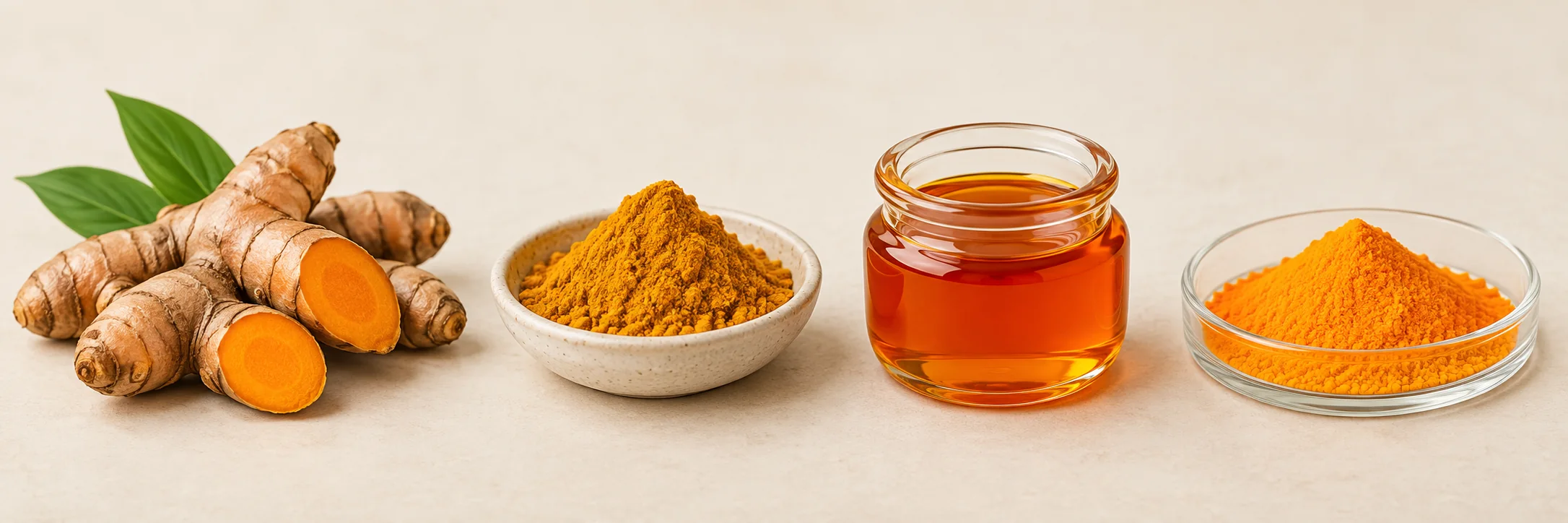
Curcumin is a single compound. Curcuminoids is the collective name for curcumin, demethoxycurcumin and bisdemethoxycurcumin, the three principal colouring components. Their proportions vary with the material. Volatile oils and resins are accompanying fractions rather than part of that three-compound total. [10][11]
| Form | Composition and processing |
|---|---|
| Ground turmeric | Milled rhizomes retain plant tissue and serve as a spice or starting material for extraction. |
| Turmeric oleoresin | A solvent extract after solvent removal, retaining some volatile oils and resins. |
| Crystalline pigment | An orange-yellow powder enriched in curcuminoids by purification, with a different flavour fraction from oleoresin. |
| Carrier-containing dispersible powder | Pigment formulated with carriers or other ingredients; its assay refers to the final blend. |
Ground turmeric differs in composition from extracted ingredients. The crystalline colour in the cited JECFA specification is insoluble in water; a carrier-containing ingredient can disperse without the pigment molecules dissolving.[10][11]
Compare turmeric procurement formats and specification fields
Applications and formulation requirements
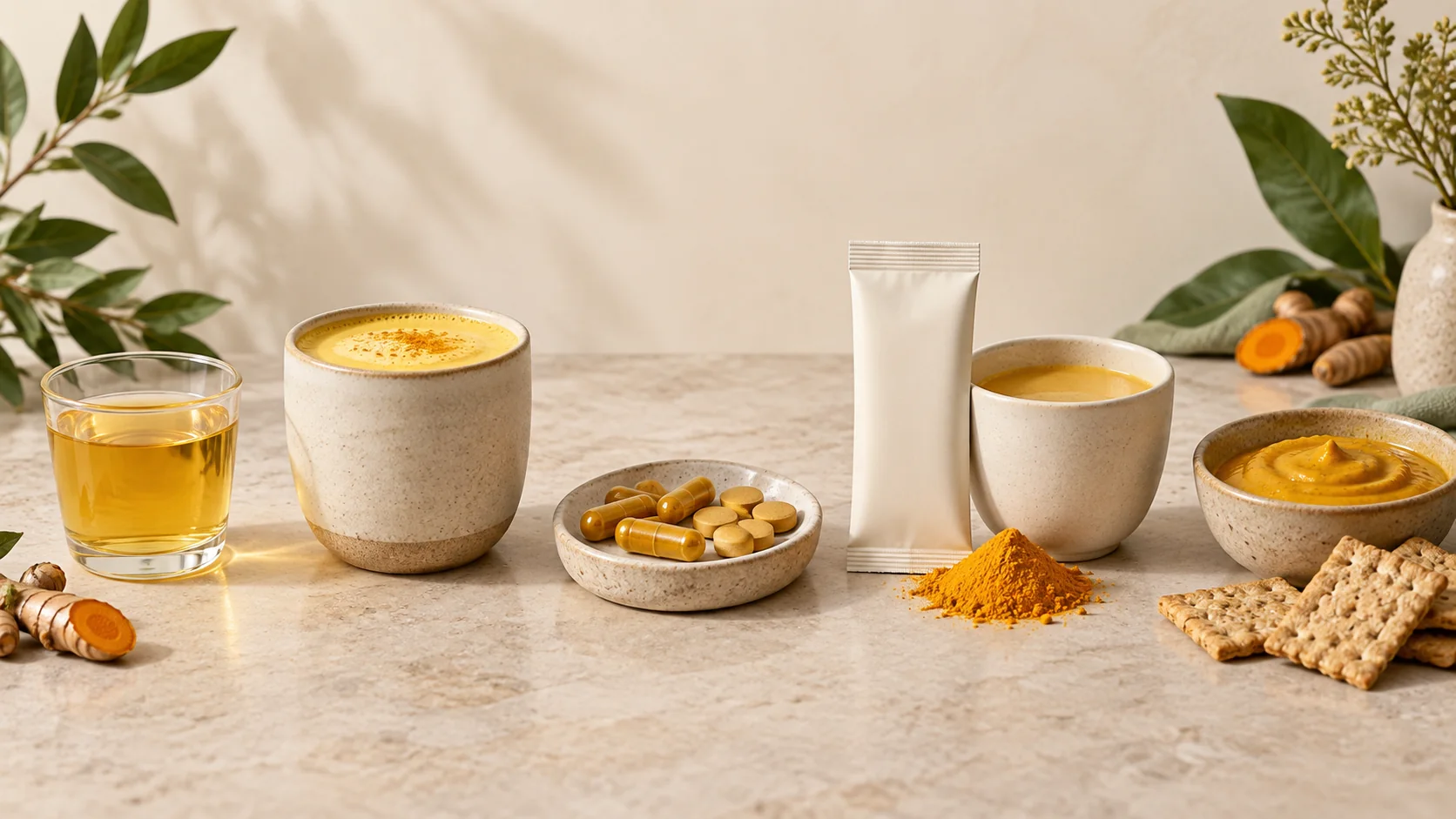
These end-product formats guide formulation trials. Decide whether the product needs flavour, colour or a specified constituent amount, then compare ingredients in the actual formulation.
| Product format | Material choice | Formulation hurdles |
|---|---|---|
| Clear beverages | Screen formulated dispersions against a clarity target; crystalline pigment is not a water-soluble ingredient. | Measure haze, sediment, oil rings and light-exposed colour at the intended addition rate, pH and heat treatment. Small droplets do not guarantee clarity. |
| Dairy and plant beverages | Start trials with a food-suitable dispersion or dispersible powder; an opaque base can accommodate some haze. | Check interactions with protein, salts and acidity, then separation, coarse particles and flavour after heating and storage. |
| Capsules and tablets | Select a standardized extract or formulated powder around the intended curcuminoid amount; carriers also occupy fill volume. | Calculate fill mass from the final-blend assay. Evaluate flow, fill uniformity and disintegration or dissolution. |
| Instant powders | Carrier-containing dispersible powders suit reconstitution trials; ground turmeric can suit a spice-led drink. | Measure wetting time, clumps, cup-bottom sediment and reconstitution after storage. Compare at equal pigment content. |
| Sauces, seasonings and baked foods | Consider ground turmeric or oleoresin for spice character; consider pigment or a suitable formulated form when yellow colour is the main purpose. | Check oil/water distribution, colour uniformity, processing heat, flavour and the use requirements for the target food category. |
These formulation checks draw on pigment solubility, oleoresin composition and emulsion research; finished foods need ingredients permitted for the intended use.[4][10][11]
Spice and colour ingredients
Oleoresins retain some of the volatile oils and resins associated with turmeric flavour. Concentrated crystalline pigment contains a larger proportion of curcuminoids and less of those accompanying fractions. The choice depends on whether the product needs spice character, colour, or both. The 2003 JECFA Curcumin monograph defines identity and purity for the food colour as an international FAO/WHO technical specification.[10][11]
End-product combinations
These trial combinations and checkpoints need testing in the target product. Flavour pairings are development choices; the cited sources support material properties and carrier-processing principles.
| Component | Role | Compatibility and processing limits |
|---|---|---|
| Ground turmeric / oleoresin / pigment | Spice and colour choices | Choose by flavour and final assay; they have different compositions.[10] |
| MCT oil + emulsifier system | Oil phase and oil–water interface | Screen phase preparation and droplet growth; the cited buffered study is not a food formula.[4] |
| Phospholipids | Complex-forming partner | Solvent-mediated complex preparation differs from final dry blending.[1] |
| HPMC / HPC | Cellulose carrier for a prepared complex | Grade, solution processing and solvent removal matter.[2] |
| Soluble starch + tocopherol + fat | Hydrophilic carrier, antioxidant and lipid components | Disclosed choices for a processed powder; ingredient permissions and residual solvents need separate review.[3] |
Plant latte or opaque beverage
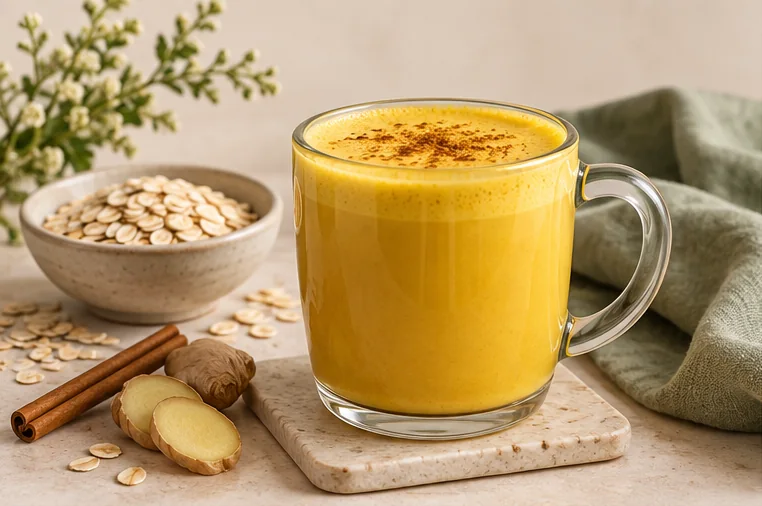
Oat or soy base + a food-suitable curcumin dispersion + optional ginger or cinnamon for a spice-led flavour. A dispersion-development route pairs curcumin with MCT oil and an emulsifier system; lecithin is one candidate, not a guarantee of stability.
Kim et al. studied curcumin in MCT with Tween-20 alone or with soy lecithin or sorbitan monooleate. Their aqueous phase contained sodium azide and bis-tris buffer: use the work to understand phase preparation and droplet growth, not as a beverage recipe.[4]
Addition order and processing
Trial sequence: prepare the pigment-containing oil phase and hydrate or disperse each emulsifier in its appropriate phase; premix, then homogenize. When using a purchased dispersion, first dilute it in a portion of the beverage base before blending into the batch. Compare the actual base before and after its intended heat treatment.
Sensory and quality checks
Keep the plant protein, salt level and acidity in the test matrix. Check flocculation, oil rings, sediment and particle growth through storage; compare bitterness, spice intensity and mouth coating against an uncoloured base. Choose light-protective packaging after a light-exposure comparison. Do not alkalize the drink just to dissolve the pigment.[10]
Instant latte powder
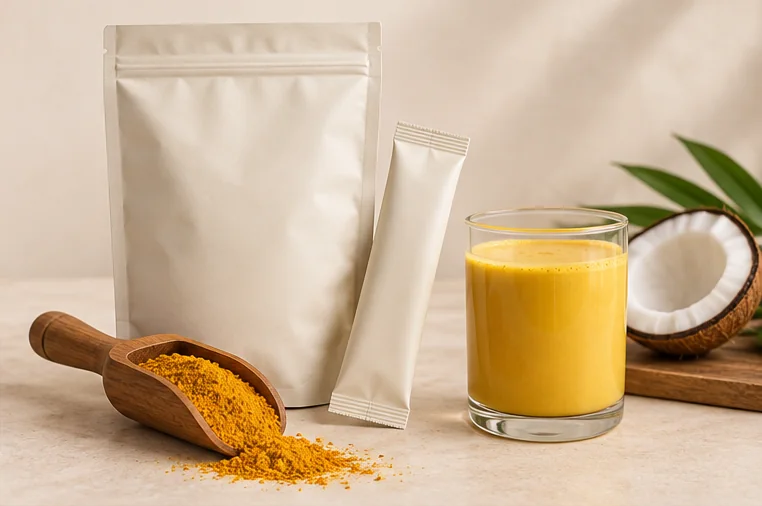
Oat or coconut powder + a carrier-containing curcumin powder + optional sugar and ginger. The base provides body and flavour; the curcumin preparation supplies colour. For carrier development, soluble starch, a permitted antioxidant such as tocopherol, and a fat are a disclosed combination rather than interchangeable dry-blend ingredients.
The OmniActive application describes curcumin, antioxidant, hydrophilic carrier and fat being processed together, followed by solvent removal and pulverization. Soluble starch, tocopherols and MCT appear among its claimed ingredient choices.[3]
Addition order and processing
Trial sequence: obtain a documented carrier powder, sieve it with the base powders, make a small premix, then blend into the remaining batch. If developing the carrier itself, treat solvent processing and drying as a separate ingredient-manufacturing step. Adding starch to crystalline curcumin at the dry blender does not reproduce the disclosed preparation.
Sensory and quality checks
Compare blends at equal assayed curcuminoid content. Measure wetting, clumps and cup sediment using specified water temperature and stirring, then repeat after humid storage. Check powder moisture, caking, blend segregation and flavour; confirm residual-solvent compliance for solvent-processed carriers.
Capsules or tablets
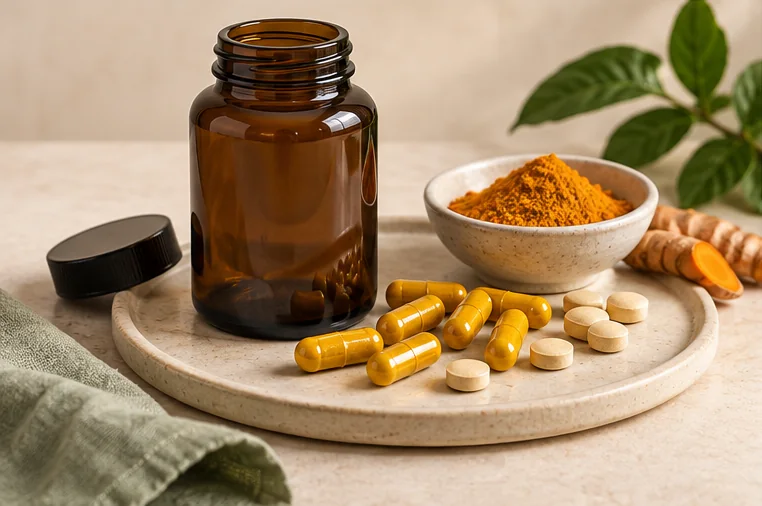
Assayed curcumin extract or prepared complex + a suitable filling or compression excipient system. Two carrier routes worth comparing are phospholipid complexes and HPMC/HPC complexes. HPMC and HPC here are hydroxypropyl methylcellulose and hydroxypropyl cellulose; a capsule shell made of HPMC is not itself a curcumin complex.
The Indena application describes phospholipid complex formation in alcoholic solvent. The Theravalues grant specifies solution processing with HPMC/HPC followed by removal of water and organic solvent; its scope is narrower than any mixture of curcumin and cellulose.[1][2]
Addition order and processing
Trial sequence: qualify the prepared complex, assay the final powder, and calculate fill mass including carrier weight. Premix with a compatible filler, then evaluate capsule filling or tablet compression separately. Do not equate simply adding lecithin or HPMC in the final blender with making the complexes.
Sensory and quality checks
Set pilot acceptance criteria for blend uniformity, flow, fill-weight variation and disintegration; tablets also need hardness and friability checks. Evaluate dissolution or release for the actual dosage form and verify residual solvents. Soy-derived phospholipids require allergen review. These examples do not use piperine as a routine absorption enhancer.
Seasoning, curry sauce or baked food
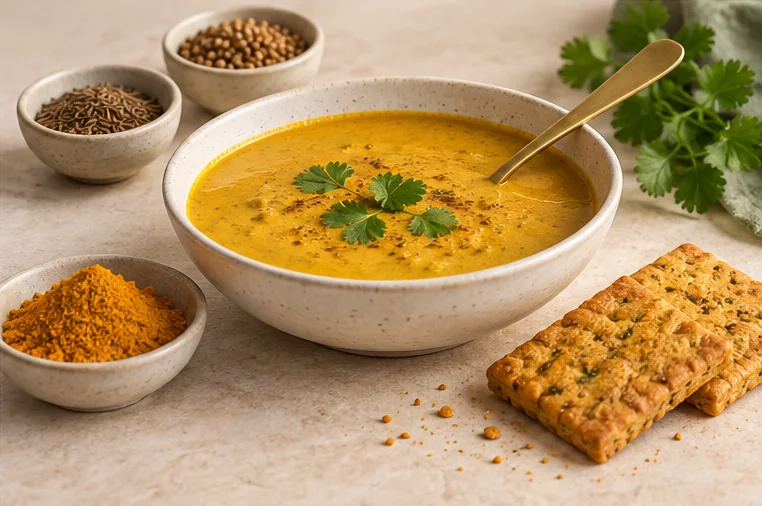
For spice character: ground turmeric + a selected coriander/cumin blend and salt. For a smoother sauce: turmeric oleoresin + the recipe’s edible oil before incorporation into the sauce. For colour with less spice character: use a documented pigment preparation rather than assuming equal weights of powder, oleoresin and purified colour are interchangeable.
JECFA describes ground turmeric in curry powders and sauces and distinguishes oleoresin, which retains volatile oils and resins, from purified pigment. It also records alkaline and light instability and colour bleaching by sulfur dioxide.[10]
Addition order and processing
Trial sequence: make a small dry seasoning premix before bulk blending; for an oil-containing sauce, first distribute the suitable oleoresin in a portion of the oil, then incorporate it under mixing. For bakery trials, compare colour before and after the actual bake rather than using the colour of the raw mix as the release target.
Sensory and quality checks
Compare yellow intensity, earthy or bitter notes and colour uniformity. Track oil separation in sauces, moisture pickup in dry blends, and shade changes from alkaline leavening or sulfite-containing ingredients. Use the current food-category rules to select permitted colour forms and usage levels; the historical JECFA discussion is not a current authorization.
Prepare procurement sample conditions and acceptance criteria
Processing and equipment by target form
Retain plant tissue
- Sieve
- Ground turmeric
Extract soluble constituents
- Solvent extraction and solid–liquid separation
- Remove solvent → oleoresin
- For enriched pigment: selective separation, crystallization and drying → crystalline pigment
Dispersible forms: further formulation
Combine a selected extract or pigment with an oil phase, emulsifiers or carriers to form a dispersion; choose drying when a powder is needed.
Branches represent product choices; crystallization, emulsification and drying are combined according to the target form.
The extraction solvent carries soluble constituents out of milled, dried rhizomes. Solvent composition, temperature, contact time and the amount of solvent relative to solids affect recovery and the accompanying oils and resins. The FAO/JECFA manufacturing account describes removing solvent to obtain an oleoresin, followed by selective separation and crystallization when a concentrated pigment is required.[10]
Milling shortens the distance that solvent and dissolved compounds travel through plant tissue. Very fine particles can make filtration slower and retain extract in the filter cake. Extraction trials therefore need both a measurement of recovered curcuminoids and an assessment of solid–liquid separation. Moisture and starting curcuminoid content provide the basis for comparing different rhizome batches.[7]
Concentration removes solvent; purification changes the proportion of pigment relative to other extracted substances. During crystallization, pigment forms crystals while some other constituents remain in the mother liquor, the liquid left after crystal formation. Washing removes adhering mother liquor, and drying reduces residual solvent. Crystal assay and total pigment recovery describe different outcomes: a purer crystal fraction can still leave substantial pigment in the liquid fractions.[10][11]
For a dispersible ingredient, formulation may include an oil phase, emulsifiers or a drying carrier. Emulsification distributes oil as droplets in water, while a carrier can support a dried formulation. These treatments change how the ingredient mixes into a product. Oleoresins, crystalline pigments and dispersible powders can require different combinations of operations; crystallization and emulsification are not compulsory stages for every form.[4][10]
Equipment follows the target form
Ground turmeric uses milling and sieving. An oleoresin route adds stirred extraction, filtration or centrifugation, and evaporation with solvent condensation and recovery. Crystalline pigment requires selective separation, crystallization, washing and drying. Dispersible ingredients use mixers or homogenizers as the formulation requires, with spray drying or freeze drying when a powder is needed. [4][10]
Ultrasound can assist laboratory extraction by improving contact and mass transfer. Its effectiveness depends on the volume, geometry and energy reaching the material. A bath power rating alone does not specify treatment intensity or predict larger-scale output. Similarly, homogenizing pressure describes one operating condition rather than production capacity.[4][7]
Quality and purchasing specifications
Turmeric extract procurement: send specifications, document and quote requirements
The specification should identify the material being purchased before giving a percentage. A useful document set links the ingredient name and form to a batch certificate of analysis, test methods and the composition of added carriers. Identity testing establishes what the material is; an assay measures how much of the specified constituent it contains; contaminant tests assess unwanted substances.[11][13]
| Specification field | Information needed |
|---|---|
| Identity and form | Botanical identity, rhizome source, extract or oleoresin/crystal/dispersion form, and traceability to the batch. |
| Curcuminoid assay | Single-compound curcumin or total curcuminoids/colouring matter; reporting basis, method and component profile. |
| Carriers and formulation ingredients | Identity and proportion of carriers, oils and emulsifiers; assay of the final blend. |
| Solvents and contaminants | Solvents used in extraction and purification, residual-solvent results, relevant elemental and other contaminant limits, and microbiological requirements. |
| Physical properties | Moisture, particle size and, where relevant, flow or reconstitution results under stated test conditions. |
The cited Curcumin specification, prepared at the 61st JECFA in 2003, requires at least 90% total colouring matter. Its assay uses absorbance at 425 nm in ethanol, with prompt measurement because the colour fades. This is a total colouring-matter result, not a claim of 90% single-compound curcumin. High-performance liquid chromatography (HPLC) can separate the three principal curcuminoids and report them individually or as a sum; results from different methods require a comparability assessment.[7][11]
That food-colour monograph gives limits of 30 mg/kg for acetone, 25 mg/kg for hexane, 50 mg/kg in the listed methanol/ethanol/isopropanol/ethyl acetate group, and 2 mg/kg for lead. These values apply to curcumin as defined in the 2003 JECFA food-colour monograph. This international specification sets identity and purity criteria; national or regional legislation defines food categories and conditions of use.[11]
For US dietary-supplement manufacturing, 21 CFR 111.70 requires component identity specifications and, as necessary, specifications for purity, strength, composition and contaminant limits, as well as controls at relevant process stages. Contractual specifications and internal process targets need to be distinguished from statutory requirements. The final carrier-containing blend needs its own assay rather than the assay of the pigment before blending.[13]
Frequently asked questions
Why does pigment settle or an emulsion separate?
Crystalline curcumin colour is insoluble in water. Suspended crystals may settle, while droplets in an emulsion may grow or migrate through the liquid. A material that disperses visibly is not necessarily molecularly dissolved. The supplied form and the composition of its oil phase or carrier help determine which measurements are relevant.[4][11]
Does a paler sample mean that curcuminoids have degraded?
Colour can change because pigment has moved into sediment or onto the container, as well as because of chemical change. For troubleshooting, compare a representative, redispersed whole-container sample with the supernatant, sediment and container rinse. Measuring only the liquid above settled solids can understate total pigment. A suitable chromatographic assay complements visual colour and particle-size measurements.[7]
Why can a dried dispersion form clumps on mixing?
Drying, storage and wetting can alter how particles associate. Assess a powder after reconstitution under stated mixing conditions, including any sediment left after standing. A liquid intermediate with small droplets is not evidence of the same distribution after drying. Light exposure, acidity and heat also merit assessment when colour retention changes.[4][10]
Study cases: materials and conditions
Literature case: analytical extraction with aqueous ethanol
A 2022 study used 100±0.5 mg commercial turmeric powder and 5 mL solvent in a 15 mL centrifuge tube. Aqueous ethanol extractions were at room temperature, with approximately 15 seconds of vortexing and 5 minutes of ultrasound, followed by centrifugation at 4000×g for 10 minutes and filtration through 0.45 μm PVDF. HPLC with diode-array detection (HPLC-DAD) measured approximately 32.22 mg/g curcuminoids with 50% ethanol and 34.26 mg/g with pure ethanol. The unit is recovered curcuminoids per gram of the tested powder under analytical extraction conditions; these values are neither industrial yields nor finished-extract purity.[7]
Literature case: curcumin in an MCT emulsion
A 2016 study started with purchased curcumin and medium-chain triglyceride (MCT) oil. Final emulsions contained 0.15 wt% curcumin, 10 wt% MCT and 10 wt% emulsifier. Three emulsifier systems were compared: 10% Tween-20; 4% sorbitan monooleate plus 6% Tween-20; and 4% soy lecithin plus 6% Tween-20.[4]
The aqueous phase contained 20 mM bis-tris buffer at pH 7.0 and 0.02 wt% sodium azide. This is a laboratory physical-stability model, not an edible beverage recipe; it must not be consumed or copied as a food formulation. Substituting permitted food ingredients or changing dilution requires new testing.[4]
Curcumin was dissolved in oil with stirring and sonication at 70°C. After adding lipophilic emulsifiers, the oil phase was stirred at 70°C for 30 minutes. Oil and water phases were premixed at 8000 rpm for 5 minutes, then microfluidized at 5000, 10000 or 15000 psi for 4 cycles. Total batch mass was not reported, so the study does not establish hourly output.[4]
At 15000 psi, the three systems had day 1 droplet sizes of 89.08, 73.43 and 67.68 nm, respectively. Dynamic light scattering (DLS) measurements were made at room temperature in triplicate after 1000-fold dilution with the same bis-tris buffer containing sodium azide. Droplet-size comparisons over 28 days at room temperature showed growth during storage. Separately, Turbiscan monitored undiluted emulsions for 3 days by changes in transmission and backscattering. The 3-day Turbiscan observation and 28-day droplet-size comparison are distinct tests; neither supplies a commercial beverage shelf life.[4]
Historical manufacturing reference
The 2004 FAO/JECFA Chemical and Technical Assessment describes oleoresin with about 25–35% colouring matter and purified powder with over 90%. These figures describe the historical route in section 3.2, not a general composition range for all products sold as turmeric extract. The compositional difference between oleoresin and purified powder illustrates pigment enrichment during separation.[10][11]
Relevant patents
Selection is based on technical relevance across extraction and purification, material delivery, quality control and end-product applications, not just formulation combinations. These four families cover purification and carrier processing. This reading list does not assess monetary value, validity or efficacy, or imply company ownership or permission to practice. Application publications and grants are distinguished; current ownership, national legal status and freedom to operate require separate professional review.
Selective purification through phenol protection and crystallization
WO2007143635A1 · PCT application publication (A1)
Material, process and claim scope
Published claim 1 starts with impure curcumin containing curcuminoids and up to about 75% curcumin by weight. It uses a phenol-protecting reagent and optional catalyst to control hydroxyl-group reactivity, then crystallizes the mixture in at least one organic solvent to obtain crystals containing at least about 99% curcumin by weight. These percentages define the published claim, not a supplier specification.[5]
Technical relevance and limits
An upstream purification route distinct from carrier formulation. It helps frame questions about separating curcumin from related curcuminoids, chemical modification of impurities, and subsequent impurity and solvent controls. It is not simple rhizome extraction or a finished-food recipe; food suitability and scale-up performance are not established by the publication.
Curcumin–phospholipid complexes
WO2007101551A2 · PCT application publication (A2)
Material, process and claim scope
Published claim 1 concerns phospholipid complexes of curcumin or extracts containing it. Claims 2–3 identify soy phospholipids, including phosphatidylcholine, phosphatidylserine and phosphatidylethanolamine. Claim 6 describes reaction of a hydroalcoholic turmeric-rhizome extract with phospholipids in an alcoholic solvent, followed by concentration and drying.[1]
Technical relevance and limits
Useful for comparing a prepared phospholipid carrier with plain extract in capsule development. The disclosed process is more specific than adding lecithin to a latte. Claims 8–9 also address pharmaceutical compositions and chemopreventive use; this is not evidence for such effects in a finished food.
Solution-processed HPMC/HPC complexes
US10245238B2 · US patent grant (B2); application US20170239194A1 published 2017-08-24
Material, process and claim scope
Granted claims 1–2 specify curcumin and/or an analog with HPMC, HPC or their mixture, an A/B weight ratio of 0.02–10, dissolution in a water/organic-solvent system (together or separately), and removal of both solvents. Claim 3 covers the complex prepared by those methods; claim 8 covers a composition suitable for oral intake containing that complex. The ratio describes claim scope, not a suggested formula.[2]
Technical relevance and limits
A route for prepared powders that can be assessed for solid dosage forms. Compare solvent residues, solid state and release, rather than assuming cellulose addition alone reproduces the material. The grant page identifies Theravalues as original assignee; it is not presented here as a current ownership determination.
Curcumin with antioxidant, hydrophilic carrier and fat
WO2012156979A1 · PCT application publication (A1)
Material, process and claim scope
Published claim 1 combines curcumin, at least one antioxidant, a hydrophilic carrier and fat, with stated depression-treatment utility. Claims 7–9 list choices including tocopherols, soluble starch and MCT. Process claim 10 combines the components in solvent, warms the mass, removes solvent by evaporation and pulverizes the dry mass.[3]
Technical relevance and limits
Relevant to carrier-powder development and the order of ingredient incorporation, not proof that a dry mix of the four components is equivalent. Solvent selection, removal and powder reconstitution require verification. The stated therapeutic use is part of the disclosure, not a health claim for an instant drink.
References
- [4] Ostwald Ripening Stability of Curcumin-Loaded MCT Nanoemulsion: Influence of Various Emulsifiers Accessed
- [7] Extractability of Curcuminoids Is Enhanced with Milk and Aqueous-Alcohol Mixtures Accessed
- [10] Curcumin — Chemical and Technical Assessment, 61st JECFA (FAO, 2004), sections 2–3 Accessed
- [11] Curcumin — JECFA specification, 61st meeting (2003), FNP 52 Add. 11; Definition, Assay and Purity Accessed
- [13] 21 CFR 111.70 -- What specifications must you establish? Accessed
Formulation and patent sources
- [5] WO2007143635A1 — Method to prepare pure curcumin; published claim 1Accessed
- [1] WO2007101551A2 — Phospholipid complexes of curcumin having improved bioavailability; claims 1–9Accessed
- [2] US10245238B2 — Composition for oral intake; granted claims 1–11Accessed
- [3] WO2012156979A1 — A water soluble composition comprising curcumin having enhanced bioavailability and process thereof; claims 1–15Accessed